Posts

Showing posts with the label nature guardian

Ninki Nanka

Image
  The Ninki Nanka is a river monster from west Africa, especially Gambia. It’s an important figure in the Mandinka people’s mythology. The Ninki Nanka has varying appearances from place to place. Sometimes it’s snake like with a horse’s head, other times it had legs but is completely reptilian and dragon like. One variation that, which has become how the Ninki Nanka is mainly known by outsiders, is that of a horse headed, giraffe necked reptile with an unusual arrangement of horns on its head and a mane done its neck. The exact arrangement of horns varies, but its usually drawn with two horns on the back of its head and a unicorn like horn on the front. The Ninki Nanka has colourful and reflective scales that allow this massive creature camouflage and hide easily. The Ninki Nanka is said to live in bodies of water, whether that be rivers, swamps or mangroves, and is most active during the rainy season. Much like the basilisk, the Ninki Nanka is said to have a deadly gaze, anyo...

Dingbat

Image
 The dingbat was a fearsome critter from the local folklore of the western Great Lakes region. It’s origin was a taxidermied mash up of different animals that was displayed in the Friendly Buck-horn Tavern in Rice Lake, Wisconsin. The dingbat had the head of some small predatory mammal, often some sort of mustelid, the body of a bird of prey, and the antlers of a young buck. The legend of the dingbat states that it revelled in making the life of hunters difficult. The dingbat would whinny like a horse just as a hunter was about to take a shot at a buck, breaking his concentration and making him miss. If that didn’t work, the dingbat was capable of flying at incredible speeds and capturing the bullet mid air. The dingbat fed on bullets and gasoline, which it would drink from the hunter’s truck, leaving him stranded. The dingbat was a humorous way for hunters to explain why they had bad luck on a hunt or came back empty handed. The Friendly Buck-horn Tavern had several taxi...

Ogopogo

Image
  Ogopogo is the most famous lake monster in Cananda. It’s found in Lake Okanagan in British Columbia It’s said to live in an underwater cave somewhere near Rattlesnake Island. The name Ogopogo comes from a 1920’s folk song The Ogo-pogo funny foxtrot , which was a satirical song making fun of local monster sightings. The name stuck. Ogopogo is described as being 30 to 50 feet long and serpentine in shape. It often travels with an undulating up and down motion, which creates humps on the surface of the water. Ogopogo has two small horns that are similar to a giraffe’s ossicones. Ogopogo is dark green to black in colour. Other details are less consistent. It’s described as having either a horse or sheep like head. Sometimes it has a hairy mane down its neck. Sometimes it has sturgeon like scales down its back and sometimes it had either a fish’s or whale’s tail. Long before settlers came to the area Ogopogo was known to the Syilx people as N’ha-a-ikt. They saw Ogopogo as ...

Khara

Image
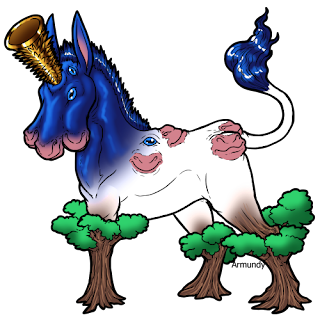
  To end off the one year anniversary month I'm featuring one of the strangest beast I've ever found in mythology, the khara. Also known as the three legged ass, it's a unicorn found in Zoroastrian mythology, which is like no other. Khara means donkey in Sanskrit, it's name in Persian is xar-i-se-pay. It's one of the oldest written accounts of a unicorn like creature and likely influenced every other unicorn from Europe and western Asia. The idea of unicorns purifying water with their horn certainly originated with the khara. The overall appearance is like a donkey, and the khara was said to be a divine donkey. It was as tall as a mountain. It had three legs that were like tree trunks. The khara had six eyes, two in the normal location, two on top the head, and two on the shoulders. With this arrangement of eyes the khara could see in all directions at once and no threat could sneak up on it. The strangest aspect of the khara is that it is covered in extra mouths...

Snawfus

Image
  The snawfus is a pure white stag with flowering branches for antlers and supernatural abilities. It comes from the folklore of the Ozarks and is found in Arkansas and Missouri. The snawfus is associated with the cool misty winters of the region. It was said to be the origin of the blue haze which shrouded the Ozark mountains in the wintertime by breathing out clouds of blue mist. Legends most often speak of their only being one snawfus, unlike many fearsome critters which are treated like species. Instead the snawfus is more like a spirit, and guardian of the Ozarks' wilderness. The snawfus was much larger than the average buck, being more akin to an elk in size. Yet in spite of this, it was far more swift than any regular deer, to the point it couldn't be captured or shot down by any means. The snawfus was also able to jump up into the canopy of the forest and walk along the branches. In spite of its size the snawfus could perch on the smallest of twigs. Sometimes it just ha...

Indrik

Image
  The indrik is a gigantic unicorn from Slavic mythology. The Indrik has ancient roots going back to Slavic paganism and predates Christianity bringing legends of western European unicorns to Russia. Its inspiration may lie with the Khara from Persia, a similarly huge unicorn. The indrik was massive, being larger than all other beasts. It was also said to be the 'father' of beasts, being both their originator and an example for them to strive towards. The indrik was associated with strength and might. It was also associated with purity and protection from evil, even before associations with western European unicorns. The indrik was the opponent of serpents, both small and monstrous. The indrik had the head of a bull, the body of a horse and the hooves of a deer. There was a large single horn in the middle of its forehead the color of amber. Although two horned depictions exist as well, usually with the horns one in front of each other, like a rhinoceros. The indrik is best kn...

Bies

Image
  Bies, also called Bes and Biesy, was a type of demon from Slavic mythology and paganism. They were known throughout eastern Europe. Bies had no consistent appearance other than it was beast like. Often depicted as either an anthropomorphic or beastial mish-mash of different animals, combining hoofed animals and predators together. It was a primeval nature spirit. Even in paganism it was considered a demon, personifying chaos, evil and everything uncontrolled in nature. Bies demons lived in mountain ranges, untouched forests and swamps, anywhere that human habitation had not encroached on nature. Beis's name means fury or rage, and was used as a euphonious for insanity, as it would cause this condition in it's victims. When a human enters the bies's home it can hypnotize and take control of the human, driving them mad and filling them with panic. If the human some how staves off such attacks and meets the bies face to face the bies will attack with more ferocity than any ...