Posts

Showing posts with the label unicorn

Nian

Image
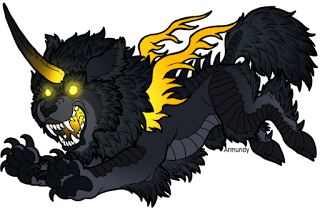
  The nian is a mythical beast from China. It is associated with the lunar new year. It’s full name nian shou means year beast, although the name is usually shortened to just nian. The nian looks like a giant lion with a single horn in the middle of its forehead. It has monstrous fangs or tusks. The niam is huge, the size of a house or larger. The legend says that each year on new years the people of a remote village would hide away in their homes in fear. The nian would come out of the ocean or the mountains, depending on where the village was said to be, and devour everything, animals, people, etc. So the people would lock their doors, hide away inside and not make a sound, for fear the nian would find them. One day an old beggar wandered into town on the evening of new years. He saw everyone running away, turning out their lights and locking their doors. He went around knocking on doors, asking for a place to stay, but no one would answer him. At one house and old ...

Gu Diao

Image
   The gudiao is a monster from China, featured in The Classic Of Mountains And Seas . It resembles a giant eagle or maybe a more gryphon like beast, as it’s sometimes described as having panther qualities too. One thing that is consistent is that the gudiao always has a single horn on its head. Often, its depicted with a bright green head as well. The gudiao was said to live on Mount Luwu, where there is very little plant life, but bountiful amounts of mineral resources, like gold and precious stones. The gudiao would prowl this mountain looking for prey. It would eat almost any animal, but it especially favoured human flesh. It’s call sounds like a baby crying, which it would use to lure people within range. Sources https://cryptidz.fandom.com/wiki/Gudiao https://chinese-mythology.com/en/wiki/gu-diao/ https://mythus.fandom.com/wiki/User_blog:RUBENHC/Creatures_and_Beings_of_China_Folklore_and_Lower_Mythology#List_of_creatures

Bo, Boma and Huanshu

Image
  Here are three unicorns from China that feel oddly western. They lack the scales and other traits that make the qilin seam more exotic. The bo is a hybrid creature and the least unicorn like of the three. The bo looks like a unicorn with the paws and fangs of a tiger. It has a white body and black tail. The bo is entirely carnivorous, and hunts leopards and tigers. It primarily lives on Mount Winding Centre where jade and metals are plentiful, according to The Classic Of Mountains and Seas. It was also said to live on the steppes of Mongolia and some isolated islands in the North Sea. It was said the bo could be tamed with some difficulty and doing so would protect you against harm during times of war. The bo was said to be a just and honourable animal. It’s call is the sound of rolling drums. Out of the three the boma has the least information available. Like the bo, it also comes from The Classic Of Mountains And Seas . The boma has a white coat, and ox’s tail and a si...

Pixiu

Image
  Tianlu Pixiu The pixiu is a mythical beast from China. It first appeared in the Han dynasty (206 BC to 220 AD) and are still popular today, although both their appearance and role have changed greatly over the centuries. Today the pixiu are bringers of wealth and associated with the practice of feng shui. Bixie Pixiu There are two types of pixiu. The bixie, or female pixiu, has two horns or antlers. It was responsible for guarding its masters and protecting them from harm. The tianlu was the male and only had one horn or antler. The male was responsible for guarding and attracting wealth. Today the bixie pixiu has largely been forgotten about and pixius are almost always depicted with one horn. Likewise the pixiu has become more associated with wealth than protection. The pixiu comes in several colors. It is often gold, to represent its association with wealth. It can also be black to represent its protective aspects. The pixiu is often depicted as white or red as well. O...

Bai ze and Hakutaku

Image
  Bai Ze is a monster from Chinese mythology. It’s also found in Japan, where it’s known as hakutaku. It is a good and pure creature responsible for warding off evil spirits. The bai ze was a wise and intelligent creature. It was one of the nine spiritual beasts which resided in heaven. Bai ze descended to Earth where it taught the Yellow Emperor about the various harmful ghosts in the world and how to expel them. These lessons resulted in the Bai Ze Diagram, a scroll depicting various harmful spirits and how to ward them off. The Bai Ze is mentioned many times throughout Chinese literature. Over time the bai ze became a protective charm. Images of the beast were hung in homes or carried with people to ward off ghosts and disease. The bai ze has many varying appearances in Chinese mythology. In the History of Yuan, written in 1370, the bai ze was described as having the head of a tiger, the body of a dragon, a single horn and a red mane. In the Sancai Tuhui, written in 1609, the ba...

Escornau

Image
  The escornau was an unusual unicorn from Ahigal, Spain. It was a vicious beast the terrorized the village sometime in the 16 th century. It was a hybrid creature with the head of a boar, ears of a rabbit, front body of a bull and back end of a horse. It had a cork screw unicorn horn in the middle of its forehead. There are two versions of its origin. Either the escornau was sent by god as a punishment for the village's sinful ways. Alternately the beast was the union between two different species of farm animal. Pretty much any combination of the four animals that make up the escornau were said to be the parents, a cow and a stallion, or a bull and a sow, or a horse and a rabbit, I honestly don't know how that one would work. Either way, there was so much sin in this village that even the farm animals per partaking in it. The escornau would use its horn as a weapon, impaling its victims with it. It would sharpen its horn on rocks to keep its tip as sharp as a spear. The be...

Khara

Image
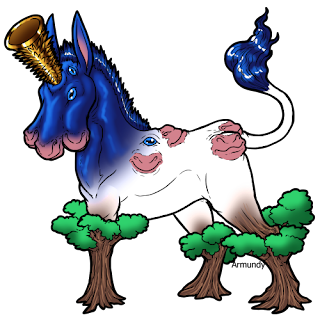
  To end off the one year anniversary month I'm featuring one of the strangest beast I've ever found in mythology, the khara. Also known as the three legged ass, it's a unicorn found in Zoroastrian mythology, which is like no other. Khara means donkey in Sanskrit, it's name in Persian is xar-i-se-pay. It's one of the oldest written accounts of a unicorn like creature and likely influenced every other unicorn from Europe and western Asia. The idea of unicorns purifying water with their horn certainly originated with the khara. The overall appearance is like a donkey, and the khara was said to be a divine donkey. It was as tall as a mountain. It had three legs that were like tree trunks. The khara had six eyes, two in the normal location, two on top the head, and two on the shoulders. With this arrangement of eyes the khara could see in all directions at once and no threat could sneak up on it. The strangest aspect of the khara is that it is covered in extra mouths...

Indrik

Image
  The indrik is a gigantic unicorn from Slavic mythology. The Indrik has ancient roots going back to Slavic paganism and predates Christianity bringing legends of western European unicorns to Russia. Its inspiration may lie with the Khara from Persia, a similarly huge unicorn. The indrik was massive, being larger than all other beasts. It was also said to be the 'father' of beasts, being both their originator and an example for them to strive towards. The indrik was associated with strength and might. It was also associated with purity and protection from evil, even before associations with western European unicorns. The indrik was the opponent of serpents, both small and monstrous. The indrik had the head of a bull, the body of a horse and the hooves of a deer. There was a large single horn in the middle of its forehead the color of amber. Although two horned depictions exist as well, usually with the horns one in front of each other, like a rhinoceros. The indrik is best kn...

Unicorns of America

Image
  You would think that belief in unicorns would have ended in the medieval era and by the time the Americas were being explored people would have moved on from such notions. On the contrary, with all the strange wildlife being discovered around the world in the age of exploration interest in the possibility of unicorns was reignited in the minds of explorers and naturalists. In 1539, in the area of New Spain which would today be New Mexico there were reports by Friar Marcos de Niza that there existed a city of gold beyond the Zuni Pueblos. He said he had visited this city and seen untold treasures there. Some of these treasures he described in great detail, including the hide of an unknown animal. De Niza said it was like that of a large bull, but had a single horn on forehead, which pointed back towards its breast. No cities or creatures like these have ever been found. Its unknown what Marcos de Niza saw, or if he had made up the entire report, and why.   The next unicorn w...

The Van Meter Visitor

Image
  In October of 1903 the town of Van Meter in Iowa had multiple encounters with a strange, bird like cryptid, which was later nick named the Van Meter Visitor. The creature had leathery, featherless skin, a bird like head with a beak filled with teeth and leathery bat like wings. The most unusual feature of the cryptid was that it had a glowing horn jutting out from the center of its forehead. Some people reported seeing a more humanoid creature, which stood upright, and had its arms replaced by bat like wings. While others reported a more animalistic and pteranodon like being. Whichever version they saw, people consistently reported the same details about its strange head. The people who reported the sightings were some of the most prominent and upstanding members of the area. The first sighting was witnessed by U G Griffith, a well know businessman in town. He was returning late at night from his work, around 1 o'clock in the morning, when he saw a light on top one of the buildi...

Xiezhi

Image
  The xiezhi was said to be a single horned ram, with black fur and burning eyes. Although in artistic depictions it more often looks like a cross between a qilin and a lion, always with a single horn or antler. The xiezhi is an ideally just beast and can intrinsically distinguish between the just and unjust people in the world. It is a highly intelligent beast and can understand all human languages. The xiezhi will hunt down evil doers and stab them with its single horn and devour them. It was believed that the legendary emperor Shun had a captive xiezhi, who would preside over court hearings and ram the guilty party. The censorate of the Ming and Qing periods wore xiezhi badges as a sign of their office. Among common people the image of the xiezhi was believed to ward off evil and protect them from crime. Similar creatures could be found in other parts of Asia. In Japan it was known as the sinyou and in Korea it was known as the haetae.  

Al Miraj

Image
  The al-miraj is one of those monsters who's on the edge of being well known. More and more people have heard of it as of recently, but few people know anything about it other than being the 'unicorn bunny'. The al miraj comes from the Arabic translations of the tale of Alexander the Great. In this account Alexander travels to Jazirat Al-Tinnin, or Sea Serpent Island. There the locals are being tormented by a serpent like dragon who is devouring their livestock. Alexander defeated the dragon by filling a cow hide with poisonous substances. The dragon subsequently swallowed the decoy and was killed. For his efforts the islanders gave Alexander the al miraj as a gift. The al-miraj is always depicted as a horned rabbit or hare that's golden yellow in color. It tends to vary more in image then it does in written description. Occasionally the al miraj is drawn with leopard spots, or a gazelle stripe, while other times it's left plain. The texts always describe the al...

Luduan

Image
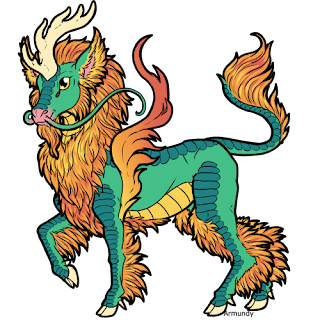
  Everyone has heard about qilins. Although fewer people realize that the qilin is not as unicorn like as it is typically depicted. The qilin was originally depicted with two horns before comparisons between it and western unicorns were made. However there are other one horned beasts in Chinese mythology, several in fact. One being the luduan, which shares many aspects with both qilin and unicorns, and had a single horn before western influence. Written descriptions of luduan depict it as deer like, green in color and having a single antler or horn. Sculptural depictions instead show the luduan as a cat like creature with paws. Legends about the luduan say it could run 18 000 li in a day (7000 km), speak every known language and detect the truthfulness of a speaker. The luduan was a peaceful creature who hated violence in any form. Accounts by Buddhist monk, Yelu Chucai say the luduan appeared before Genghis Khan and convinced him to abandon his conquest in India. Although it's ...

Monoceros

Image
      The monoceros is an animal that is mentioned by many Greek and Roman authors. Many people assume the monoceros was just a rhinoceros, however its description differs quite a bit from a mere rhino, and it was probably a mythical amalgamation of different animals. The description was added to multiple times by subsequent authors, further elaborating on the monoceros's attributes.      The monoceros was first mentioned by  Megasthenes, who was a Greek explorer who travelled to India. It's likely out of all the authors who wrote about the monoceros, Megasthenes was the only one who actually saw a rhinoceros. Yet, his description still doesn't quite fit a rhino, as he said the creature had the head of a stag and a horn two cubits long, which would be nearly 3 feet. The monoceros was also said to live in the foothills of the Himalayas, rather than in the lowlands where rhinoceros are actually found. Still Megasthenes' description does have a fair bit i...

Zheng

Image
  There's not much information on this creature. The zheng is mentioned in The Classic Of Mountains And Seas, which is a compilation of mythic geography and beasts, similar to the medieval bestiaries from Europe. The zheng was described as a red leopard with a single horn and five tails. It was ferocious and brutal, as you would expect from a large cat. And it sounded like striking stones. It lived high up on Mount Zhang'e, above the tree and grass line, where there was only stone. In spite of it's fanciful appearance, the zheng was considered a natural animal.