Posts

Showing posts with the label misidentified animal

Succarath

Image
  The succarath, also known as the su, was a monster Andre Thevet reported from Patagonia. The beast was described as having a very short face, similar to either that of a human or a cat. It had a red beard and lion like mane. The body was very skinny, with a deep chest in the front and narrowing to the back. The tail was very bushy and held over its back. The succarath carried its young on its back and sheltered them with its tail. The creature had long legs for running, and was quite quick and agile. The succarath was a carnivore and a capable hunter, comparable to a large cat. While Andre Thevet was the first person to write about the succarath, he wasn’t the only one. Other explorers such as Conrad Fore, Ambroise Pare and Juan Eusebio Nieremberg all mentioned the succarath. Each of these explorers all write about the succarath as a completely natural animal, and not hearsay from local legend. It was said that the local Tehuelche natives would hunt the succarath for its...

Yale

Image
  The yale was a goat or antelope from medieval bestiaries and heraldry. Its name might comes from the Hebrew word yael, meaning ibex, or the Greek word eilo, meaning to roll or swing. It’s also known as the eale and the centicore The Yale’s most notable feature is its large horns, which it can swing around to point forward or back at will. It was believed the forward pointing horns were used as an offensive attack, while the horns pointing backwards were better for defence. Being able to switch between the two made the yale unparalleled in combat. In addition to this the yale also had boar like tusks. It was also huge, being comparable in size to a hippopotamus. The yale first appeared in the writings of Pliny the Elder. Here, and in medieval bestiaries the yale is described as a stocky bull like animals with black fur. It was likely based on misinterpretations of a cape buffalo. Over time the yale morphed into a more goat or antelope like animal. It also gained a yell...

Questing Beast

Image
   The questing beast is a hybrid monster from Arthurian Legend. It’s also known as the Beast Glatisant, which is related to the french word glapissant, which means yelping or barking. In the Vulgate and earlier cycles describe a creature with the head of a lamb which is white, the legs of a dog which are black and the body of a fox which is red. In the post-Vulgate cycles the questing beast takes on a more familiar form of having the head of a snake, the front body of a leopard, the back half of its body of a lion, and the feet of a deer. The sound of barking dogs constantly issues from the questing beast’s belly, causing it to constantly flee from hunting dogs it can never escape, hence both its names. Even within this later description there’s a large amount of variation. In the Vulgate Estoire Del Saint Graal , the questing beast appears briefly at the beginning of the story, guiding a narrating character to the book containing the story of Arthur, making this ve...

Xiphis

Image
  The xiphis was a confusing animal that appeared on two Roman mosaics, one was the Nile Mosaic of Palestrina and the other in the House of the Physician in Pompeii. It’s a heavy bodied creature, similar to a rhino or hippopotamus, with a long snout and carnivorous teeth similar to a crocodile. Many theories have been put forth to explain what the xiphis is. Most people assume it’s just a poor rendition of a hippopotamus. That might be the case for the House of the Physician, but there’s a much more realistic hippo on the Palestrina mosaic. Rhinos and crocodiles have also been suggested, but these also appear in the Palestrina mosaic. As well the animals on the Palestrina mosaic have their names written under them as part of the mosaic, with the hippo, rhino, and crocodile clearly labelled. The name xiphis comes from the labelling on this mosaic. Xiphis was a type of sword in Rome, not an animal, but this may have been part of a longer name or out interpretation of it is miss...

Cetus

Image
   In ancient Greece cetus referred to sea monsters in general, as well as whales, as they didn’t see a difference between the two, and it was seen as the ocean equivalent of the draikon, or dragon. While cetus was thought of as a type of monster, rather than an individual, there are two myths about notable individual cetus, the Trojan cetus, which was killed by Heracles, and the Ethiopian cetus, which was killed by Perseus. There were two main ways the cetus was depicted. One was as a bulky sea beast with the head of a boar and the tail of a whale, sometimes with paws. Another was a more serpentine creature, with the head of a greyhound, and it’s long serpent tail ending in a whale fluke. Even though there are two major cetus myths, both appearances were equally associated with both myths interchangeably, rather than each being a specific monster. The Trojan Cetus was sent by Poseidon to torment King Laomedon. Laomedon had asked Poseidon to build the walls of Troy f...

Orabou

Image
  The orabou was a creature reported by André Thevet during his journeys, sometime in the 1600 th century. The creature was seen in the waters near Mount Marzouan. No mountain is named Mount Marzouan today, so it’s unknown which mountain this was supposed to be, but it was believed to be near the Red Sea. The orabou was a fish cat hybrid with an unusually humped back. The creature was covered in armour like scales that Thevet compared to brigantine armour. The orabou was nine to ten feet long. It made sounds similar to a cat. According to Thevet, the locals would occasionally fish and eat the orabou, even though the meat was said to cause kidney stones. The locals would treat the kidney stones with a folk remedies made from herbs and the orabou’s own fat. Thevet tried some of the orabou’s meat while he was there. He said it was foul tasting and compared it to preserved camel meat. The orabou was said to be extremely ferocious towards other sea life. Much thought has ...

Marool

Image
  The marool is a sea monster from the Shetland Islands in Scotland. It’s a mythological interpretation of a monk fish. In addition to the monk fish’s already strange appearance, the marool has a multitude of eyes on its head and a fiery crest in place of a back fin. The marool is about the size of a dolphin, which is larger than a real monk fish, but still not that big for a sea monster. The marool takes great pleasure in watching ships sink and sailors drown. It stirs up the sea and causes a glowing sea foam known as mareel. The marool also sings during storms and sea swells. It’s voice in haunting and causes fear. Sources https://britishfantasysociety.org/10-fearsome-foes-from-scottish-folklore/ https://abookofcreatures.com/2016/03/04/marool/

Physeter

Image
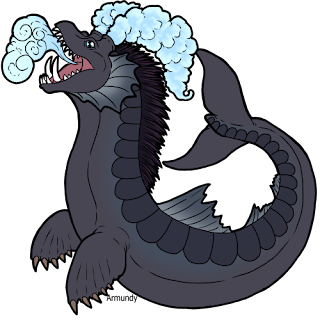
  In the medieval era and earlier, so little was know about whales that they were regarded in the same manner as dragons and sea serpents. Today physeter, meaning blower or whirlpool, is the genus name of sperm whales. And while the name always referred this species of whale, what was believed about their appearance and behavior was worthy of being called a mythical beast. The earliest surviving accounts of physeter was from Pliny the Elder. He states that it was the largest beast in the Sea of Gaul, today known as the North Atlantic. According to Pliny the physeter would rise itself up in a column above the masts of ships and spray out water from its head in a fountain like torrent. The physeter was often found in medieval bestiaries, where it was described as a giant fish with a horse like head and neck. It's head had two spouts from which it could spray out water. A horse like mane ran down the back of its neck. Often the depiction would end here, with the body hidden beneat...

Odontotyrranus

Image
  The odontotyrranus is a giant and fearsome monster that attacked Alexander the Great as he entered India. The beast is described as being larger than an elephant, having a bull like body, and horse like head. Its most notable features were three large horns on its head and a wide mouth full of predatory teeth. The beast was also semi-aquatic and wallows in water like a hippopotamus. It was black in color and its head was darkest. Its name means toothy tyrant. The legend of the odontotyrranus states that Alexander's men made camp by a river after entering India. Two different versions state that the odontotyrranus either came down to the river to drink, or was wallowing in the water and lunged out of the river at them. Alexander's men fought the beast as it rampaged through their camp. It killed 26 men and injured 52. The odontotyrranus was carnivorous and able to swallow a human whole with ease. One of Alexander's commanders, Emendus, Duke of Arcadia finally brought the b...

Ambize

Image
  I'm starting a new thing, I'm going to do the monster alphabet. I've already found and planned out monsters for every letter, even q and x. So this week we're starting with A. The ambize angulo, better known to the internet as the ambize (pronounced am-bee-zay, ending like say or day), is an aquatic monster from the Congo River and its tributaries. It straddles the line of folklore and cryptid, being part of the local folk tales and being encountered by 17 th century European travellers. The ambize is described as a cross between a pig and a fish, having the overall form of a fish with a pig's head and blubbery skin. It has a rounded tail that is swung up and down while swimming, like a sea mammal. The ambize's most bizarre feature is that it has giant fleshy human hands in place of fins. Although this appears to be a feature that has been exaggerated with time, as earlier reports give it more proportional human arms in place of the hand fins, which is still ...

Beast of Gévaudan

Image
In the years between 1764 and 1767 there was a string of some of the most bizarre animal attacks on farmers in history. In the French region of G é vaudan close to 300 people were reportedly killed by an unknown animal, who's species has never been identified. G é vaudan was a remote, mountainous and heavily forested region in southern French, which is now part of Loz è re. It was rugged and rural, the majority of people lived as shepherds and wood cutters. People didn't have access to the education and advancements of the enlightenment found in the more populous northern regions of France. For the average farmer life had changed little from the medieval era. The local noble ruler, the Marquis D'Apcher, spent most of his time in the royal court at Versailles, so actual leadership of the communities in G é vaudan was in the hands of the church and local elders. Rural people here lived a meagre life filled with hunger and hardship. Further compounding the hardships for the...

Calopus

Image
  Many real creatures were turned into mythical beasts in the Medieval era. The hyena inspired the crocotta, the wildebeest the bonnacon and the ibex the yale. Yet few beasts have strayed so far from their real life inspiration as the antelope and the calopus. The antelope was first known in Europe by the ancient Greeks, who called it antelopos. The records of Alexander the Great called them aeternae and the Romans called them calopus, which means pretty foot. The name calopus continued through the Medieval period as a mostly separate creature from antelopes. Medieval bestiaries varied on whether they had entries on the calopus, antelope or both. Eventually the calopus became a symbolic beast in heraldry, where it gained its most unfamiliar form yet. The antelope known to the ancient Greeks was considered a fearsome beast, yet it still had the overall form of a goat or a roe deer. The calopus had dangerous serrated horns which it used to shred tree branches. It would hesitate to ...

Monoceros

Image
      The monoceros is an animal that is mentioned by many Greek and Roman authors. Many people assume the monoceros was just a rhinoceros, however its description differs quite a bit from a mere rhino, and it was probably a mythical amalgamation of different animals. The description was added to multiple times by subsequent authors, further elaborating on the monoceros's attributes.      The monoceros was first mentioned by  Megasthenes, who was a Greek explorer who travelled to India. It's likely out of all the authors who wrote about the monoceros, Megasthenes was the only one who actually saw a rhinoceros. Yet, his description still doesn't quite fit a rhino, as he said the creature had the head of a stag and a horn two cubits long, which would be nearly 3 feet. The monoceros was also said to live in the foothills of the Himalayas, rather than in the lowlands where rhinoceros are actually found. Still Megasthenes' description does have a fair bit i...