Posts

Showing posts with the label protector

Amabie, Amabiko and Arie

Image
 This week I have three very similar yokai for you. All three of them became popular in the Edo period. They would emerge from the ocean and relay almost identical prophecies. The prophecy said that there would be several years of prosperity and good harvests (usually 8 years, but the exact number varied) then there would be hardship and an outbreak of disease. The three yokais also said to use their image to protect people against the oncoming disease. This all came about while Japan had a series of devastating cholera and typhoid outbreaks, hence why people were interested in yokai that protected from disease. There were actually several more yokai who played a similar role, but varied more than these three. Either their origin was somewhere other than the ocean, or their prophecy differed slightly, but still warned of oncoming disease. These three however, copy each other almost identically other than appearance and their exact location. The first is amabiko, which itself is th...

El Cadejo

Image
  The cadejos are ghostly black dogs from Central American legend. They are similar to the black dog legends from England, except there are two different cadejos, one is black and evil, and the other is white and good. The cadejo’s appearance varies greatly from region to region. However most of the time they have hooves like a goat on both feet. Sometimes they have goat horns as well. The black one is sometimes said to drag a chain behind it too. The white cadejo has blue eyes and the black cadejo has fiery red eyes. Cadejos are very large for dogs, being comparable to the size of a cow. Legend has it that God sent the white cadejo to protect people who were out at night, people travelling along country roads, drunks and people down on their luck. The devil saw this and was so angered by it he created the black cadejo to attack those same people. The cadejos most often interact with people in the country side, especially farmers who live near volcanoes. It’s said before...

Pixiu

Image
  Tianlu Pixiu The pixiu is a mythical beast from China. It first appeared in the Han dynasty (206 BC to 220 AD) and are still popular today, although both their appearance and role have changed greatly over the centuries. Today the pixiu are bringers of wealth and associated with the practice of feng shui. Bixie Pixiu There are two types of pixiu. The bixie, or female pixiu, has two horns or antlers. It was responsible for guarding its masters and protecting them from harm. The tianlu was the male and only had one horn or antler. The male was responsible for guarding and attracting wealth. Today the bixie pixiu has largely been forgotten about and pixius are almost always depicted with one horn. Likewise the pixiu has become more associated with wealth than protection. The pixiu comes in several colors. It is often gold, to represent its association with wealth. It can also be black to represent its protective aspects. The pixiu is often depicted as white or red as well. O...

Bai ze and Hakutaku

Image
  Bai Ze is a monster from Chinese mythology. It’s also found in Japan, where it’s known as hakutaku. It is a good and pure creature responsible for warding off evil spirits. The bai ze was a wise and intelligent creature. It was one of the nine spiritual beasts which resided in heaven. Bai ze descended to Earth where it taught the Yellow Emperor about the various harmful ghosts in the world and how to expel them. These lessons resulted in the Bai Ze Diagram, a scroll depicting various harmful spirits and how to ward them off. The Bai Ze is mentioned many times throughout Chinese literature. Over time the bai ze became a protective charm. Images of the beast were hung in homes or carried with people to ward off ghosts and disease. The bai ze has many varying appearances in Chinese mythology. In the History of Yuan, written in 1370, the bai ze was described as having the head of a tiger, the body of a dragon, a single horn and a red mane. In the Sancai Tuhui, written in 1609, the ba...

Makara

Image
  The makara is an aquatic chimera originating in Hindu mythology, but also found in Buddhism. It's legend is known in many countries, including India, Sri Lanka, Nepal, and all over South East Asia. The name makara means water monster in Sanskrit. The legend of the makara is very old, as images of it date back to the Vedic era (1500 BCE). The Makara's appearance is extremely varied. At it's most basic the makara is a chimera of mammal in the front and a water living creature in the back. The most common combinations are an elephant or stag head with a crocodile, fish or whale body. The makara may also have a peacock's tail on occasion. Older depictions of the makara had even more animals mixed in, in addition to the ones listed above it could also have boar's tusks, lion's paws and mouse's ears. The makara symbolized the might and power of water, such as floods, rapids and tides. It also represented the dangerous animals that lived in water, especially cr...

Denglong

Image
  Denglong, also known as Wangtianhou, Chaotianhou and Hou, is a chimeric beast from Chinese mythology. It's sometimes considered a dragon and other times its own type of creature. Denglong has the qualities of several other animals: antlers of a deer, a camel's head, cat ears, shrimp eyes, a donkey's mouth, lion's mane, snake neck, sea serpent's belly, carp scales, eagle's talons and tiger's back legs. Incidentally, this list of features is very similar for Chinese dragons, who are often similarly described as having the features of many common animal. Denglong said to be one of the sons of the dragon emperor, although I didn't see it listed when researching the nine sons before. Yet Denglong looks very similar to Chaofeng's beast form and there may be some confusion between them, similar to how cockatrice and basilisk are used interchangeably in European mythology. Denglong is said to be the most powerful of beasts. And is capable of fighting and ...

Khara

Image
  To end off the one year anniversary month I'm featuring one of the strangest beast I've ever found in mythology, the khara. Also known as the three legged ass, it's a unicorn found in Zoroastrian mythology, which is like no other. Khara means donkey in Sanskrit, it's name in Persian is xar-i-se-pay. It's one of the oldest written accounts of a unicorn like creature and likely influenced every other unicorn from Europe and western Asia. The idea of unicorns purifying water with their horn certainly originated with the khara. The overall appearance is like a donkey, and the khara was said to be a divine donkey. It was as tall as a mountain. It had three legs that were like tree trunks. The khara had six eyes, two in the normal location, two on top the head, and two on the shoulders. With this arrangement of eyes the khara could see in all directions at once and no threat could sneak up on it. The strangest aspect of the khara is that it is covered in extra mouths...

Nine Sons of the Dragon

Image
 The nine sons of the dragon are a group of hybrids and dragons that were the sons of the dragon emperor, usually either Longwang or Huanglong. Each of these character were used as motifs or decorations on objects, believed to impart their power or skill into the object. While there's always said to be nine sons in total, the list of sons varies greatly. There are some core members that end up on all lists, while others appear only occasionally as one of the sons. Dragons are often associated with the number nine, being a combination of nine different animals, having nine forms they pass through as they age, and having scales in multiples of the number nine. The order of the sons also changes with every list. But Bixi is consistently the eldest son. Consistent members: Bixi Bixi The eldest son. A turtle dragon hybrid who is associated with foundations, strength and dependability. He is depicted at the bottom of pillars, seemingly holding them on his back or shell.   Bi'...

Shinchu

Image
  Shinchus are good monsters and considered holy. They are protective minor deities and are known as the divine insects. While shinchus look terrifying they only attack demons, especially those which cause disease. Shinchus violently rip these demons apart, leaving a trail of gore and blood. Every day a shinchu will devour six thousand demons, three thousand in the morning and three thousand in the evening. It's said the shinchu's appetite is as big as it is. Shinchus are silk moths the size of elephants or larger. They have bulging eyes, gaping mouths full of sharp teeth and a wasp like stinger. According to the myth, shinchus originated in India in the mythical lands of Jambudvipa. Of the four lands surrounding Mount Meru, Jambudvipa is the only one inhabited by humans and the only one where enlightenment could be achieved in one life time purely through study. Because such things could be achieved only in this one land it was under constant attack from demons who wanted to s...

Xiezhi

Image
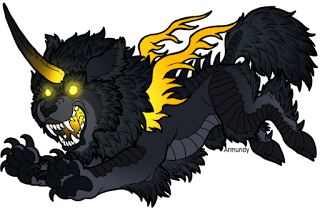
  The xiezhi was said to be a single horned ram, with black fur and burning eyes. Although in artistic depictions it more often looks like a cross between a qilin and a lion, always with a single horn or antler. The xiezhi is an ideally just beast and can intrinsically distinguish between the just and unjust people in the world. It is a highly intelligent beast and can understand all human languages. The xiezhi will hunt down evil doers and stab them with its single horn and devour them. It was believed that the legendary emperor Shun had a captive xiezhi, who would preside over court hearings and ram the guilty party. The censorate of the Ming and Qing periods wore xiezhi badges as a sign of their office. Among common people the image of the xiezhi was believed to ward off evil and protect them from crime. Similar creatures could be found in other parts of Asia. In Japan it was known as the sinyou and in Korea it was known as the haetae.