Posts

Showing posts with the label boogeyman

Ninki Nanka

Image
  The Ninki Nanka is a river monster from west Africa, especially Gambia. It’s an important figure in the Mandinka people’s mythology. The Ninki Nanka has varying appearances from place to place. Sometimes it’s snake like with a horse’s head, other times it had legs but is completely reptilian and dragon like. One variation that, which has become how the Ninki Nanka is mainly known by outsiders, is that of a horse headed, giraffe necked reptile with an unusual arrangement of horns on its head and a mane done its neck. The exact arrangement of horns varies, but its usually drawn with two horns on the back of its head and a unicorn like horn on the front. The Ninki Nanka has colourful and reflective scales that allow this massive creature camouflage and hide easily. The Ninki Nanka is said to live in bodies of water, whether that be rivers, swamps or mangroves, and is most active during the rainy season. Much like the basilisk, the Ninki Nanka is said to have a deadly gaze, anyo...

Hagg Worm

Image
 The hagg worm was a type of flying serpent found in Cumbria, in England. It’s considered a dragon, but most acknowledge it’s quite different from the typical idea of a dragon. They didn’t breath fire like a normal dragon, and they may have been venomous, but it’s never mentioned. These creatures were large hairy, flying snakes. It’s never said whether they flew on feathered or bat like wings, but the more ghoulish option the better. The exact size of these flying serpents is never stated, but they are large enough to swallow magpies in one quick gulp like a swallow catching flies. And large enough to be a threat to people. You might hear the name hagg and immediately think of hags, those hideous old crones from Scottish legend who would eat children. Although the word hagg is from old English, meaning swamp, and was later applied to both hags and the hagg worms, because that’s where they lived. Specifically, the hagg worms lived in the forested swamps outside of the town of Ar...

Bukavac

Image
   The Bukavac is a monster from southern Slavic folklore, primarily Serbia and some parts of Croatia. It is said to lurk in lakes, rivers and swamps. There it hunts for any wanders and drowns people. The bukavac has six legs, multiple gnarled horns and a long tail. Other than this its appearance is quite variable. Sometimes its depicted as a frog or salamander like monster, other times its more humanoid, like some sort of amphibious water ogre. The Bukavac mostly comes out at night, that’s when it’s most dangerous. It’s known for its loud howls or screams. The name bukavac coming from the Serbian word buka, meaning noise or roar. Besides drowning people, its also known for jumping on the backs of anyone passing by a water source at night and terrorizing them until they shake the bukavac off, or they too succumb to drowning. The bukavac is also capable of controlling water and the weather, and is able to whip up whirlpools and storms. There are two different origins of...

Stratford Lyon

Image
  The Stratford Lyon is a local legend from New Forest, an area in the southwest of England. It rests somewhere between folklore and cryptid, with people reportedly seeing the beast in modern times, but it’s hard to tell how serious these encounters are. Legend has it that in the early 1500’s a local aristocrat named John Stratford was walking the land he had newly inherited. While travelling his land he spotted some antlers sticking out of the ground. They were magnificent, huge antlers. So John Stratford tried to pull them out of the ground. As he pulled he saw that the antlers were attached to fur, then a lion’s head and finally the whole lion’s body emerged. The lion was furious and lunged at Stratford. He hung onto the antlers for dear life, narrowly dodging the lion’s swipes at him. As the lion struggled Stratford jumped on its back. The lion bucked and fought back but Stratford hung on and refused to be removed. With Stratford on its back, the lion ran around New ...

Kallikantzaros

Image
   The kallikantzaros are small demons or goblins from modern Greek folklore. They’re associated with the Christmas season, which is when they appear and cause mischief in people’s lives. The kallikantzaros look like small, hairy, demons. They have small horns, fur covering their bodies, split hooves, and donkey like ears and tails. Their size varies from child sized to insect sized, but they’re always smaller than an adult human. In Greek Orthodox Christianity the twelve days of Christmas come after Christmas Day, and represent the time between Jesus’s birth and his baptism. During this time spirits and malevolent forces are able to run amok on Earth. While this is happening people must be especially religiously observant or they will fall prey to the various evil forces. It’s during this time the kallikantzaros come to Earth. For most of the year the kallikantzaros spend their time in Hell. They busy themselves trying to saw through the world tree that holds Earth ...

Pale Crawler

Image
  Pale cralers are a type of cryptid that is reportedly seen by people all over the world. They have an overall humanoid appearance. They are very light in colour, with pale, white, pink or grey skin, almost like a corpse. Pale crawlers are very skinny, to the point of looking emaciated, often with twig like limbs and the outline of bones visible under their skin. Crawlers are always hairless all over, having no body hair, head hair, or even eyebrows. Their eyes are extremely sunken in, giving them a skull like appearance. They can have jet black eyes, or glassy cataract like eyes, or eyes that shine in dim light like an animal’s. Pale crawlers are rarely reported with ears, any that have them are small and vestigial. Pale crawlers sometimes have animal like claws, other times they have more human like nails. The fingers are always long and skinny, regardless of what they’re tipped with. Pale crawlers stand very tail when fully upright, somewhere between eight to ten feet tall. M...

Nachtkrapp

Image
  The nachtkrapp is a boogeyman that haunts Germany, Austria, Denmark, Norway, Sweden and Poland. It’s name in German means night raven. The exact details of the legend vary quite a bit regionally. Sometimes it appears as a raven, or as a more human like undead being, or as a shadowy, shape shifting ghost. It also varies in size from huge, to human sized, to the size of an ordinary raven. The nachtkrapp is used as a cautionary tale to scare children into behaving. It’s said the nachtkrapp only comes out at night. If the nachtkrapp sees a child out at night it will carry the child off to its nest, rip the child apart limb from limb and eat its heart. Some tamer versions of the legend only have the Nachtkrapp putting children in a large bag it carries over its back and doesn’t say what’s done with them after that. The nachtkrapp has hollow skeletal eye sockets. If anyone looks into its empty eye holes they die instantly. Depending on the region the nachtkrapp is said to ha...

Lancaster Chimera

Image
  This was a little known monster that appeared in Lancaster County, Pennsylvania during the summer of 1973, where it terrorized the Amish community. The creature has no official name, but has been referred to as the Amish Country Goat Man, The Mystery Beast and humorously The Goose Grabber. This monster defies categorization and has been lumped in with bit foot, dog man, goat man and the Sheepsquatch, yet it doesn’t neatly fit with any of them. It is a unique being. One thing is for sure, the Amish don’t give up their paranormal stories to outsiders easily. So the fact that they contacted outsiders over these events showed how frightened they were. The first encounter happened to two brothers in the evening, as they were bringing in the hay at the end of the day. While they were working their horses started to startle like a predator was near by. The two brothers went looking for the cause, suspecting a coyote or bear was near. Instead they saw a grey, indistinct bipedal fig...

El Cadejo

Image
  The cadejos are ghostly black dogs from Central American legend. They are similar to the black dog legends from England, except there are two different cadejos, one is black and evil, and the other is white and good. The cadejo’s appearance varies greatly from region to region. However most of the time they have hooves like a goat on both feet. Sometimes they have goat horns as well. The black one is sometimes said to drag a chain behind it too. The white cadejo has blue eyes and the black cadejo has fiery red eyes. Cadejos are very large for dogs, being comparable to the size of a cow. Legend has it that God sent the white cadejo to protect people who were out at night, people travelling along country roads, drunks and people down on their luck. The devil saw this and was so angered by it he created the black cadejo to attack those same people. The cadejos most often interact with people in the country side, especially farmers who live near volcanoes. It’s said before...

Capelobo

Image
   The capelobo is a monster from the Par á and Maranh ã o regions of Brazil. It is mainly believed by the Christianized indigenous population. The name comes from the Guarani word cap ê , meaning bend legged or lame, and the Portuguese lobo, meaning wolf. The capelobo is a vampiric monster that drinks both blood and brain matter with its long snout. It starts out as an elderly indigenous man, if he dies without a Christian burial or becomes lost in the forest he will transform into the capelobo. This transformation is permanent and he can never return to his human form. The capelobo looks like a werewolf with an anteater’s head and clawed forelimbs. It also has perfectly round horse hooves, which look the same back to front. This makes it impossible to know what direction the capelobo was travelling when trying to track it. The capelobo is very large, being close to seven feet tall, even when hunched over in a bestial werewolf fashion. Some say the capelobo has a feral f...

Kamikiri

Image
  Kamikiri is a yokai from the Edo period of Japan. It sits on the edge between legendary creature and cryptid, with newspaper articles about encounters with the creature coming out at the time, yet being treated as folklore now. Although the line between yokai and cryptid isn’t always clear. The kamikiri is a yokai who’s all about cutting off people’s hair. In previous eras in Japan long hair was a symbol of age and status. Both men and women had long hair, men wearing their hair in top knots and women in various styles. There was a much greater need to conform in Japan’s past, people wore hairstyles based on status and role in society, rather than for fashion. So having your hair cut off was far worse for the person that it would be in modern times. The kamikiri would lurk around its victim in secret and wait for a time they were alone to attack. They would then quickly and silently cut off the victim’s hair. Often the kamikiri would never be seen and the victim would only kn...

Striga

Image
  A striga is a vampire like demon from Slavic and Polish folklore. It has owl like features, such as feathers, golden eyes and bird like talons. It can also shape shift into an owl at will. Strigas are strictly nocturnal, coming out at night to feast on the blood and flesh of the living. A striga comes from a person, usually female, that was born with two souls. This person will have various signs that they have two souls, usually having duplicated body parts, such as having two rows of teeth or two heartbeats. If this person is found out in life, they will be cast out of society to go die in the wilderness. If they're not found out they will continue to live like a normal person while they're still alive. On death one of the souls moves onto the afterlife while the other stays trapped in the body. When this happens the stiga begins to transform. They'll start out looking like they did in life, just with pale grey skin. Over time they will transform, gaining long need...

Ushi Oni

Image
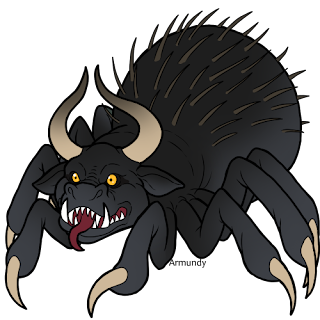
  The ushi oni is a monstrous yokai found in western Japan, usually along the coast or near rivers and waterfalls. The name mean ox demon. The most common depiction of the ushi oni is one with a bull's head and a spider's body. Although the spider part is just supposed to represent 'a form of demonic evil' and isn't inherently connected to spiders. However the name ushi oni refers to many local monsters with varying appearances. Ushi onis are cruel and violent monsters. They almost exclusively eat people. Occasionally they are said to attack live stock, but this is usually to lure people out. Ushi onis also breath out toxic gas and spread a variety of diseases. Ushi onis have a variety of behaviors and ways of hunting people. Some lay in wait in their layers and pounce upon unaware victims. These layers are usually along the coast in sea caves, as well as inland in dangerous river features such as whirlpools and waterfalls. Some rare ushi oni live far inland,...

Skeljaskrimsli

Image
  Skeljaskrimsli is a monster or cryptid that was reportedly seen on Icelandic beaches from between the 1780's to the 1910's. Its name means shell monster. Alternately known as fjorulalli (beach walker) or Saeulfur (sea wolf). The skeljaskrimsli is a large bear shaped creature. Individuals vary in size from wolf sized to horse sized. The creature has long fangs or tusks, long claws, an arched back and long tail that ends in a club. It's most notable feature is its coat of shells or pangolin like scales completely covering its body except the belly and lower limbs. These shells would rub together and create a lot of noise, warning of its presence. The creature was dark in color, like mussel shells, with red eyes and sometimes a bioluminescent mouth. People could hear the skeljaskrimsli approaching long before it was seen. As it came closer it also gave off a powerful stench. It's fortunate that this creature gave such warnings of its approach, as it was quite violent. ...

Nguruvilu

Image
  The nguruvilu is a monster from Mapuche legend in Chile. It looks like an elongated fox, which can coil around like a snake. It's still fur covered like a fox. It has long sharp claws. The name nguruvilu means fox snake in Mapuche. The nguruvilu lives an amphibious life in rivers and can hide itself in the form of common water creatures. It's a dangerous trickster who drags people underwater and drowns them. The nguruvilu can make the water deep or shallow. It can make the river look inviting to lure people in and can also make whirlpools and rapids at will. It delights in drowning lone victims and watches the village morn. The only way to get rid of an nguruvilu is through the efforts of a machi, the Mapuche version of a shaman. At the river's edge the machi will make offerings to the gods and good spirits to protect him. Then he will dive underwater and guided by good magic will capture the nguruvilu in the form of a fish, frog or snake. He then threatens the nguruvi...

Llamhigyr Y Dwr

Image
  The llamhigyr y Dwr was a troublesome water spirit from Wales, especially well known from the lakes of Llyn Gwynant and Llyn Glas. Its name means water leaper. The llamhigyr y dwr had a large frog like head, bat wings for forelegs, no back legs and a long lizard like tail ending in a spike. The creature was quite large, comparable to a crocodile. While the llamhigyr y dwr was capable of flight it preferred to hide beneath the water. The llamhigyr y dwr would devour anything that would fit in its mouth. Shepherds wouldn't bring their flocks to the lake to drink, and people would keep their dogs and children away from the waters edge. If the llamhigyr y dwr's target managed to escape its reach it would use it tail like a whip to grab and pull its prey back into the water. Otherwise it would just leap out from the water's edge mouth first and swallow its prey whole. The llamhigyr y dwr would also rob bate and catches off fishing lines, and even overturn boats in an attempt t...

Jimplecute

Image
  The jimplecute is a vampiric reptile from Ozark legend. It is a rarely heard of fearsome critter and shouldn't be confused with the gowrow, the more famous reptile from the region. There are two different descriptions of the jimplecute. The original appearance is of a long serpentine reptile, yet still baring short legs. It has skin the texture of dead leaves, which allows it to hide better in the forests. It even had the chameleon like ability to change color, so to blend in with leaves of different seasons. This jimplecute is able to wrap around its victims like a python to immobilize them while it feeds on their blood. The more modern version of the jimplecute is of a vampiric dinosaur, usually something similar to a raptor. This interpretation comes from the book We Always Lie to Strangers by Vance Randolph, which is a book about Ozarks folklore. There Mr Randolph describes the jimplecute as a prehistoric. Although I think he meant that all reptiles are primitive in his e...

Frau Perchta and the Straggeles

Image
  The straggeles are a group of Christmas demons from Switzerland, Austria and the alpine parts of Germany. They are the helpers of Frau Perchta, the crone of winter. She's a supernatural witch who's responsible for punishing the naughty during the holiday season. The straggeles are also known as the perchten, as they're Perchta's followers. Perchta is seen as a complex character, having both good and bad aspects. She's the upholder of cultural rules, and there for while she casts curses on people and sends her straggele demons out to torment them she does it for a purpose, to punish those people who ignore cultural traditions. Straggels look very similar to Krampus, the main difference being Krampus is an individual demon where as there are multiple straggeles. The exact number is never specified. Straggeles have a typically demonic face with a hooked nose, sharp chin, jagged teeth and glaring eyes. They have large goat horns on their heads, ranging in number from...

Nuckelavee

Image
  Nuckelavee is a prominent figure in the folklore of the Orkney Islse, Scotland. He is the most evil and malevolent of all the unseelie fae folk, more comparable to a demon than anything else. Nuckelavee would spend most of his time resting in the sea, only occasionally venturing onto land to torment people. Nuckelavee had the appearance of a horse with a human torso emerging out of its back, like a mutated rider who had merge with their horse. The whole monster was skinless, every muscle and sinew showing. Nuckelavee's body was covered in yellow pulsing veins which carried black blood. The human torso was quite misshapen too. The head was massive, too big for the neck and would roll side to side as Nuckelavee walked. Nuckelavee's arms were so long that even positioned on horse back would reach all the way to the ground. The most terrifying detail was that Nuckelavee had one singular eye that would glow like a lantern through even the thickest night and fog. Although it's ...

Plat Eye

Image
  The Plat Eye is a ghostly undead monster from America Folklore. It's found along the gulf coast, into Georgia and up into South Carolina. The legend of the plat eye was told primarily among African Americans. The plat eye is a ghostly predatory beast, usually a large cat. Its most distinguishing feature is its single large eye, which glows red. Often all a person will see of the plat eye is its glowing eye staring at them from the darkness. The plat eye's body is pale white or grey, like a lifeless corps. Often its flesh is rotten and its guts are hanging out, furthering the undead appearance.   The plat eye can shape shift into the forms of a headless human, a sickly black calf or a black dog. The plat eye can also appear and disappear at will. Plat eyes haunt bayous and crossroads after midnight, and are never seen in the light of day. They fade out of existence in the sunlight. The plat eye surrounds itself in mist and appears out of the fog. Plat Eyes are the restl...