Posts

Showing posts with the label demon

Kallikantzaros

Image
   The kallikantzaros are small demons or goblins from modern Greek folklore. They’re associated with the Christmas season, which is when they appear and cause mischief in people’s lives. The kallikantzaros look like small, hairy, demons. They have small horns, fur covering their bodies, split hooves, and donkey like ears and tails. Their size varies from child sized to insect sized, but they’re always smaller than an adult human. In Greek Orthodox Christianity the twelve days of Christmas come after Christmas Day, and represent the time between Jesus’s birth and his baptism. During this time spirits and malevolent forces are able to run amok on Earth. While this is happening people must be especially religiously observant or they will fall prey to the various evil forces. It’s during this time the kallikantzaros come to Earth. For most of the year the kallikantzaros spend their time in Hell. They busy themselves trying to saw through the world tree that holds Earth ...

Lancaster Chimera

Image
  This was a little known monster that appeared in Lancaster County, Pennsylvania during the summer of 1973, where it terrorized the Amish community. The creature has no official name, but has been referred to as the Amish Country Goat Man, The Mystery Beast and humorously The Goose Grabber. This monster defies categorization and has been lumped in with bit foot, dog man, goat man and the Sheepsquatch, yet it doesn’t neatly fit with any of them. It is a unique being. One thing is for sure, the Amish don’t give up their paranormal stories to outsiders easily. So the fact that they contacted outsiders over these events showed how frightened they were. The first encounter happened to two brothers in the evening, as they were bringing in the hay at the end of the day. While they were working their horses started to startle like a predator was near by. The two brothers went looking for the cause, suspecting a coyote or bear was near. Instead they saw a grey, indistinct bipedal fig...

Horned Dogmen

Image
This entry is going to indulge in some original research. Something I’ve noticed among dogman encounters is the occasional mention of horned dogmen. The cryptid community is usually pretty thorough in classifying subtypes of cryptids. For instance there’s standard, hyena and rottweiler types of dogmen, based on their head and muzzle shape. Yet I haven’t seen anyone else in the cryptid community discuss horned dogmen as a category, just scattered unrelated stories. It’s possible that’s because these creatures aren’t always considered dogmen, but demons, or goatment who happen to have a canine head, although I would think that quality is important enough to change what sort of cryptid they’re classified as. So I’ve gathered here all the horned dogmen stories I could find.  Caldwell’s beasts This first encounter happened to Roger Caldwell in October of 2005. He was on a hiking trip along the Appalachian Trail through North Carolina at the time. Mr Caldwell was an experienced hiker who...

Alber

Image
  The Alber is a demon or dragon from the legends of the Ziller Valley in Tyrol. It’s said to live on Teufelseck mountain, the mountain’s name meaning ‘devil’s corner’. At times the Alber would descend from the mountain, towards Ziller Valley as a giant fiery dragon, flying through a hole in the cliffs called the Bleiarzkar and down to the valley, spreading plagues, war and famine. It was thought the Alber was the devil himself in dragon form. Legend tells of two men from the village of Meran who witnessed the flight of the Alber and were lucky enough to survive such sights. One was the tailor Hanser, who was a wicked and dishonest man. He partook in every sort of sinful activity, lying, scamming, idleness and debauchery. The other was Loaserer Sepps, a good and honest villager. One night Hanser made a bet with his equally loathsome friends to steal cherries from the cherry tree in the yard of the Mission Cross of Algund. But Hanser was a coward and wouldn’t travel out there at nig...

Striga

Image
  A striga is a vampire like demon from Slavic and Polish folklore. It has owl like features, such as feathers, golden eyes and bird like talons. It can also shape shift into an owl at will. Strigas are strictly nocturnal, coming out at night to feast on the blood and flesh of the living. A striga comes from a person, usually female, that was born with two souls. This person will have various signs that they have two souls, usually having duplicated body parts, such as having two rows of teeth or two heartbeats. If this person is found out in life, they will be cast out of society to go die in the wilderness. If they're not found out they will continue to live like a normal person while they're still alive. On death one of the souls moves onto the afterlife while the other stays trapped in the body. When this happens the stiga begins to transform. They'll start out looking like they did in life, just with pale grey skin. Over time they will transform, gaining long need...

Zburator

Image
  The zburator is a type of demon from Romanian mythology. The name means flyer. The zburator's true form is that of a wolf with draconic features and bat like wings. It's often depicted with fire as well, either being surrounded by flames, or having a mane or tail of flame. This is especially prevalent when the zburator flies across the sky at night in the form of a shooting star. The zburator is capable of shape shifting. Most often it takes on the form of a handsome young man. It uses this capability to visit women at night and temp them into sleeping with it. The zburator most favours women who are engaged, or otherwise in a relationship but not married yet, and takes great delight in convincing these women to cheat on their partners. Zburators are often invisible to all except the women they pursue. Zburators drain their victim's life force through sex, much like an incubus. This leaves their victims tired, pale and anemic. Zburators are often compared to vampires, e...

Yeongno

Image
The yeongno is a demon from korea. There is little written about it and no folk tails where it appears. Instead the yeongno come from korean theatre, specifically small local plays to entertain the common folk. The type of theatre it appears in is the gamyeongeuk, a type of play where actors wear masks to play stalk characters, and the Kkokdugaksinoreum, a puppet show. These plays with the yeongno were performed to mock the yangban. The yangban were the wealthy elites of past Korea's highly stratified society. In these plays the yeongno is banished from heaven for some crime which isn't eluded upon. To reenter heaven the yeongno has to eat 100 yangban. The yeongno would creep up on the yangban and play it's willow pipe with a distinct bibibi tune, to strike fear in the yangban who was being stalked. This gives the yeongno it's alternate name of Bibi. The yeongno costume consists of a mask with a long crocodile like snout, and a long robe or blanket with scale pattern...

Ushi Oni

Image
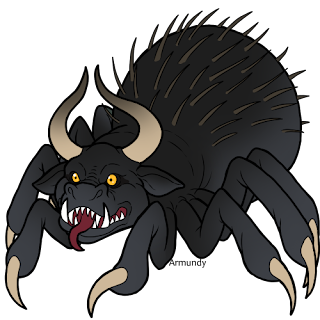
  The ushi oni is a monstrous yokai found in western Japan, usually along the coast or near rivers and waterfalls. The name mean ox demon. The most common depiction of the ushi oni is one with a bull's head and a spider's body. Although the spider part is just supposed to represent 'a form of demonic evil' and isn't inherently connected to spiders. However the name ushi oni refers to many local monsters with varying appearances. Ushi onis are cruel and violent monsters. They almost exclusively eat people. Occasionally they are said to attack live stock, but this is usually to lure people out. Ushi onis also breath out toxic gas and spread a variety of diseases. Ushi onis have a variety of behaviors and ways of hunting people. Some lay in wait in their layers and pounce upon unaware victims. These layers are usually along the coast in sea caves, as well as inland in dangerous river features such as whirlpools and waterfalls. Some rare ushi oni live far inland,...

Falak

Image
  Falak is a gigantic snake from Arabian legend. It's larger than the whole world combined. Falak resides in the abyss, the seventh and final level of hell. The other levels of hell are held in its mouth. In Arabian mythology the world is carried on the back of an angel, who stands on the celestial bull Kuyuta, who in turn stands on the whale (not dragon) Bahamut. Bahamut in turn swims in the celestial ocean, which are the surface waters leading to the abyss. Falak desperately wants to reach up out of the abyss and devour all these other beings and the whole world. It's only the fear of God's punishment that stops Falak from doing so. God also gave Falak the other six levels of hell to hold to keep it busy and not focused on destroying the world.  

Azi Dahaka

Image
  Azi Dahaka, also known as Zahak, was a dragon in early Persian mythology. He first appears in the Avesta and the later Denkard texts of the Zoroastrian religion. The legend of Azi Dahaka continued in folklore after the Muslim conquest of Persia, where he appeared in the epic poem Shahnama. Azi Dahaka was described as a three headed dragon, unlike other person dragons, which are usually single headed and long bodied, like an evil version of far eastern dragons. In the Avesta Azi Dahaka was the son of Ahriman. Even though he was a dragon he had the intellect and cunning of a human, and could take human form. With his human cunning Azi Dahaka was so evil he committed every form of sin. Later in the Shahnama, Azi Dahaka, then named Zahak, was said to be a human 'blessed' with evil magic and foresight by Ahriman, but Ahriman's touch leaves two snakes which grow from Zahak's shoulders which must be fed with human flesh. In the Avesta Azi Dahaka lived in Babylon and worshipp...

Aitvaras and Pukis

Image
  Aitvaras are a type of malicious house spirit from Lithuanian mythology. They look like purely black or white roosters with flaming tails while inside the house, and like small dragons outside. When they fly they look like a comet streaking across the sky. Aitvaras hatch from eggs of a 9 to 15 year old rooster. Don't ask how a rooster would lay eggs, although it's a motif I've noticed popping up in mythology occasionally. The aitvaras would serve a family in a household through deceptive means. It would bring wealth and good fortune to the household by stealing from the neighbours. The aitvaras would go on nightly flights to rob them. Owning an aitvaras would inevitably bring strain between the household and the rest of the community. Additionally, the aitvaras would slowly siphon away the souls of the residents, damning them. Once an aitvaras was inside a house it was very difficult to remove. Killing it would be difficult as it would heal as soon as it touched the floor...

Frau Perchta and the Straggeles

Image
  The straggeles are a group of Christmas demons from Switzerland, Austria and the alpine parts of Germany. They are the helpers of Frau Perchta, the crone of winter. She's a supernatural witch who's responsible for punishing the naughty during the holiday season. The straggeles are also known as the perchten, as they're Perchta's followers. Perchta is seen as a complex character, having both good and bad aspects. She's the upholder of cultural rules, and there for while she casts curses on people and sends her straggele demons out to torment them she does it for a purpose, to punish those people who ignore cultural traditions. Straggels look very similar to Krampus, the main difference being Krampus is an individual demon where as there are multiple straggeles. The exact number is never specified. Straggeles have a typically demonic face with a hooked nose, sharp chin, jagged teeth and glaring eyes. They have large goat horns on their heads, ranging in number from...

Nuckelavee

Image
  Nuckelavee is a prominent figure in the folklore of the Orkney Islse, Scotland. He is the most evil and malevolent of all the unseelie fae folk, more comparable to a demon than anything else. Nuckelavee would spend most of his time resting in the sea, only occasionally venturing onto land to torment people. Nuckelavee had the appearance of a horse with a human torso emerging out of its back, like a mutated rider who had merge with their horse. The whole monster was skinless, every muscle and sinew showing. Nuckelavee's body was covered in yellow pulsing veins which carried black blood. The human torso was quite misshapen too. The head was massive, too big for the neck and would roll side to side as Nuckelavee walked. Nuckelavee's arms were so long that even positioned on horse back would reach all the way to the ground. The most terrifying detail was that Nuckelavee had one singular eye that would glow like a lantern through even the thickest night and fog. Although it's ...

The Nameless Horror of Berkeley Square

Image
  The nameless horror of Berkeley Square is the most Lovecraftian thing I've heard of that wasn't written by Lovecraft himself or his circle of writers. The name of the thing even sounds Lovecraftian. Yet these events predate Lovecraft's writing. Most of them happen before he was even born. The nameless horror is intrinsically tied to it's location, 50 Berkeley Square in London England. It is known as one of the most haunted buildings in all of London. The building itself has a long history being built in 1740. Not long after it already was reported to be haunted. The first stories about specific spirits started in 1789. Adeline, a woman who had lived in the house, was found dead outside on the pavement. She had jumped from the upper floors to escape abuse from her uncle. After her untimely death people started seeing her apparition as a ghostly woman in white wandering the hallways, and disconnected crying from an unseen woman. Another early ghost from the 18 th cen...