Posts

Showing posts with the label early modern

Mississippi Monster

Image
  The Mississippi monster is one of those old time cryptid stories that appeared in 19 th century news papers. And like many of these stories it pushes the limits of what can be believed. Although I find this monster in particular pushes those limits more than most. Stories like the Swan Valley monster had a bizarre creature that defies biology, but only a small number of witnesses and ultimately the creature didn’t do very much. The Ape Canyon attack has lots of action and damage, which should leave a paper trail of police reports and insurance claims that can be verified if someone where to look deep enough, but involves big foot, one of the more reasonable cryptids to exist. The Mississippi monster involves both a confounding monster that is like nothing else alive, and over the top damage, which should be able to be verified by its own paper trail. However the story takes place long enough ago that such things like insurance claims and repair reports of company owned ships wo...

Slide Rock Bolter

Image
   The slide rock bolter is a fearsome critter from Colorado. It’s whale like in shape and size, in spite of being an entirely land based creature. On the ends of its tail fins are hooks that allow it to grab onto mountain ridges. It has tiny eyes and a large gaping mouth, much like a sculpin. The bolter also constantly drools out an oily slippery saliva that surrounds it. The slide rock bolter lives only on the steepest cliff sides, ones that are over 45 degrees. There it remains in wait, hanging high up on the cliff side watchful for its prey. The slide rock bolter’s primary prey is tourists, although it will eat practically any creature it catches unaware. When it spots prey in the valley bellow it lets go of the cliff with its tail hooks and slides down the side of the mountain like an avalanche, flattening anything in its way and leave and trail of destruction. Helping the slide rock bolter slide down the hillside is the ample drool it left behind before, as this a...

Keythong

Image
  The keythong is a gryphon like beast, which is supposed to have come from heraldry, but it’s history is more complicated than that. It looks like a gryphon, but without wings. It has spikes on various parts of its body, often on its legs, back, and a fan of spikes on its shoulders where the wings should be. It also have a pair of swept back horns on its head. I say its history is complicated, because while both the name and appearance of the keythong appeared historically used in heraldry, they didn’t come together to mean the same creature until modern times when the internet took interest in the creature. The name keythong appears to have been created as late as the 19 th century. It comes from J R Planche’s Pursuivant Of Arms, he describes the coat of arms for the Earl of Ormonde as having rampant keythong on the right. However, what is actually shown on the arms is a wingless gryphon with flames, no horns or spikes. https://en.wikipedia.org/wiki/Earl_of_Ormond_%...

Dingbat

Image
 The dingbat was a fearsome critter from the local folklore of the western Great Lakes region. It’s origin was a taxidermied mash up of different animals that was displayed in the Friendly Buck-horn Tavern in Rice Lake, Wisconsin. The dingbat had the head of some small predatory mammal, often some sort of mustelid, the body of a bird of prey, and the antlers of a young buck. The legend of the dingbat states that it revelled in making the life of hunters difficult. The dingbat would whinny like a horse just as a hunter was about to take a shot at a buck, breaking his concentration and making him miss. If that didn’t work, the dingbat was capable of flying at incredible speeds and capturing the bullet mid air. The dingbat fed on bullets and gasoline, which it would drink from the hunter’s truck, leaving him stranded. The dingbat was a humorous way for hunters to explain why they had bad luck on a hunt or came back empty handed. The Friendly Buck-horn Tavern had several taxi...

Ogopogo

Image
  Ogopogo is the most famous lake monster in Cananda. It’s found in Lake Okanagan in British Columbia It’s said to live in an underwater cave somewhere near Rattlesnake Island. The name Ogopogo comes from a 1920’s folk song The Ogo-pogo funny foxtrot , which was a satirical song making fun of local monster sightings. The name stuck. Ogopogo is described as being 30 to 50 feet long and serpentine in shape. It often travels with an undulating up and down motion, which creates humps on the surface of the water. Ogopogo has two small horns that are similar to a giraffe’s ossicones. Ogopogo is dark green to black in colour. Other details are less consistent. It’s described as having either a horse or sheep like head. Sometimes it has a hairy mane down its neck. Sometimes it has sturgeon like scales down its back and sometimes it had either a fish’s or whale’s tail. Long before settlers came to the area Ogopogo was known to the Syilx people as N’ha-a-ikt. They saw Ogopogo as ...

Dingonek

Image
  The dingonek was an African cryptid known from lake Victoria and the surrounding rivers. It was first reported by big game hunter John Alfred Jordan. The incident first made its way to the media through another big game hunter’s book, In Closed Territory , by Edgar Beecher Bronson, in which he recounted Jordan telling the story to him. Jordan’s encounter happened in 1905. The okapi has recently been discovered. So Jordan had a network of local peoples always on the lookout for unusual large game that wandered into the area, in the hopes of discovering a new species himself. One day his informants told him that a reptilian beast was spotted up the Maggori River. So Jordan and his hunting party, two local men named Mataia and Mosoni, headed up the river in canoes to find the beast. Mataia and Mosoni scouted ahead. They soon came racing back down the river in pure terror, insisting the beast was resting on the river’s shore just ahead. Jordan insisted his two men come with h...

Kallikantzaros

Image
   The kallikantzaros are small demons or goblins from modern Greek folklore. They’re associated with the Christmas season, which is when they appear and cause mischief in people’s lives. The kallikantzaros look like small, hairy, demons. They have small horns, fur covering their bodies, split hooves, and donkey like ears and tails. Their size varies from child sized to insect sized, but they’re always smaller than an adult human. In Greek Orthodox Christianity the twelve days of Christmas come after Christmas Day, and represent the time between Jesus’s birth and his baptism. During this time spirits and malevolent forces are able to run amok on Earth. While this is happening people must be especially religiously observant or they will fall prey to the various evil forces. It’s during this time the kallikantzaros come to Earth. For most of the year the kallikantzaros spend their time in Hell. They busy themselves trying to saw through the world tree that holds Earth ...

Ponik

Image
  Ponik is an aquatic reptile that allegedly lives in Lake Pohenagamook, in eastern Quebec, near the border with Maine. It’s a very active cryptid with over 1000 sightings since the 1800’s. Although its activity comes in waves, with some decades having many more sightings than others. The 50s where the peak of Ponik sightings. The monster’s appearance varies quite a bit from different reports. The most consistent thing is that it has two or three humps on its back and a saw tooth ridge down its back. It’s said to be anywhere from 35 to 60 feet long. Some people have reported that Ponik is a giant fish, the saw tooth ridge on its back being the diamond shaped scales of a sturgeon. However sturgeons don’t live in Lake Pohenagamook, and even if they did this would be a record breaking size for a sturgeon. Other people report a serpentine shaped monster, while others still a more reptilian body with either four legs or four flippers. Those who’ve seen its head describe...

Moha Moha

Image
  The moha moha is a cryptid from Australia, spotted on June 8 th , 1890. It was seen my Selena Lovell, a school teacher and amateur naturalist, as well as a group of people accompanying her, while they were on an outing to Great Sandy Island. The creature was well known to the natives, who called it the moha moha, or danger turtle, as it was known for attacking their fishing camps and grabbing their legs in the water. With all the other strange Australian wildlife discovered Ms Lovell didn’t question the creature’s odd appearance and wrote up a report on it. This report was then used by Willian Saville-Kent to publish a formal description of the creature in Land And Water and give it the name Chelosauria lovelli. Little did either of them know that this creature would only ever be seen once, and become the topic of controversy. The moha moha had a rounded head that was more like that of a lizard or other reptiles than a standard turtle. Ms Lovell didn’t see any nostrils and...

Hellidid

Image
  The hellidid is one of the fearsome critters of American folklore. Unlike most other fearsome critters, it’s found in the deserts of the south west. It is a chimeric monster with the head of an ant eater, the body of a zebra and four ostrich like legs, and a fluffy tail. The hellidid primarily ate fibrous plants, such as yuccas. It would use its long, serrated tongue to lick at the plants, scraping off the soft bits and leaving the fibre within the leaves behind. The hellidid was also extremely shy and would run off, allowing only quick glimpses of the creature. However, at night it would approach travellers sleeping out in the open and use its rough tongue to lick all the hair off their heads, leaving them shaved in the morning. Obviously the legend of the hellidid was part of a prank cowboys would play on greenhorns and people who overslept, shaving their heads, and blaming it on the hellidid. Sources https://www.deviantart.com/monstrumamericanum/art/Hellidi...

Cahokia Dragon

Image
  What follows is the least modern of the modern dragon sightings I’ve researched, although it’s far from the medieval era where dragons belong. On October 5 th of 1877 a farm boy named Johnny Smith witnessed an epic battle between one of his bulls, and reportedly, a real dragon. All of this happened outside Saint Louis, about seven miles away from the ruins of the ancient city of Cahokia. In the farming community surrounding Saint Louis the Smith family was well known for being honest. Lead by their father Jabez, he was a pillar of truthfulness and practicality, never giving into any form of exaggeration or flights of fancy, to the point where he was known as truthful Jabez. Under his strict discipline his sons followed suit. So when his son Johnny reported seeing a monster fight their bull, and came home with a badly injured bull, people believed him, no matter how fanciful the events sounded. Around 4pm that day Johnny Smith had been sent out to collect one of t...

Kamikiri

Image
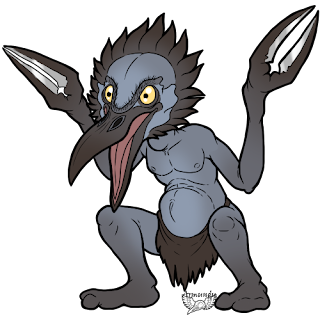
  Kamikiri is a yokai from the Edo period of Japan. It sits on the edge between legendary creature and cryptid, with newspaper articles about encounters with the creature coming out at the time, yet being treated as folklore now. Although the line between yokai and cryptid isn’t always clear. The kamikiri is a yokai who’s all about cutting off people’s hair. In previous eras in Japan long hair was a symbol of age and status. Both men and women had long hair, men wearing their hair in top knots and women in various styles. There was a much greater need to conform in Japan’s past, people wore hairstyles based on status and role in society, rather than for fashion. So having your hair cut off was far worse for the person that it would be in modern times. The kamikiri would lurk around its victim in secret and wait for a time they were alone to attack. They would then quickly and silently cut off the victim’s hair. Often the kamikiri would never be seen and the victim would only kn...

Beither

Image
  The beithir is a Scottish dragon. It inhabits mountainous regions, near water. Hiding out in caves and steep mountain valleys. Unlike other European dragons the beithir lacks wings or fire breath. Instead it’s highly venomous and has a poisoned sting. It’s also associated with ice and lightning. The beithir was considered the largest and most deadly of serpents. In addition to its other abilities the Beithir was cunning and had the ability to shape shift. The beithir would lurk in high mountain valleys near water and wait for passing victims. When an unlucky person would enter the territory of the beithir the dragon would sting their victim. The stung person then had to run to the nearest water and wash off the sting. If they made it to the water before the beithir then they were saved. If the beithir reached the water first then the victim would be devoured. It was believed that if a snake was killed then its head and body had to be separated from each other by quite a distance,...

Salt Lake Fire Drake

Image
  The Salt Lake Fire Drake is a flying cryptid seen near the Great Salt Lake in Utah. It was seen once in 1903, and again just under a hundred years later, in 2001. This cryptid is often touted as a living pterosaur, however in my research I found this cryptid to be something far stranger. On September 3rd, 1903, a flying creature was seen by multiple witnesses on Stansbury Island, in the south end of the Great Salt Lake. Two hunters, John Barry and Martin Gilbert, gave the most detailed report of the creature. They described it as equal mixes of bat, fish and alligator, having the head of an alligator, the wings of a bat and the tail of a fish. In addition the creature was covered in either thick, rough scales, or salt accretions from the lake. The creature got its name from the fiery rainbow iridescence of its wings, shining with reflected sunlight. The two men described the monster as being prehistoric in nature, although they didn’t specifically say it was a pterosaur. Othniel ...