Posts

Showing posts with the label united kingdom

Hagg Worm

Image
 The hagg worm was a type of flying serpent found in Cumbria, in England. It’s considered a dragon, but most acknowledge it’s quite different from the typical idea of a dragon. They didn’t breath fire like a normal dragon, and they may have been venomous, but it’s never mentioned. These creatures were large hairy, flying snakes. It’s never said whether they flew on feathered or bat like wings, but the more ghoulish option the better. The exact size of these flying serpents is never stated, but they are large enough to swallow magpies in one quick gulp like a swallow catching flies. And large enough to be a threat to people. You might hear the name hagg and immediately think of hags, those hideous old crones from Scottish legend who would eat children. Although the word hagg is from old English, meaning swamp, and was later applied to both hags and the hagg worms, because that’s where they lived. Specifically, the hagg worms lived in the forested swamps outside of the town of Ar...

Stratford Lyon

Image
  The Stratford Lyon is a local legend from New Forest, an area in the southwest of England. It rests somewhere between folklore and cryptid, with people reportedly seeing the beast in modern times, but it’s hard to tell how serious these encounters are. Legend has it that in the early 1500’s a local aristocrat named John Stratford was walking the land he had newly inherited. While travelling his land he spotted some antlers sticking out of the ground. They were magnificent, huge antlers. So John Stratford tried to pull them out of the ground. As he pulled he saw that the antlers were attached to fur, then a lion’s head and finally the whole lion’s body emerged. The lion was furious and lunged at Stratford. He hung onto the antlers for dear life, narrowly dodging the lion’s swipes at him. As the lion struggled Stratford jumped on its back. The lion bucked and fought back but Stratford hung on and refused to be removed. With Stratford on its back, the lion ran around New ...

Gurt Worm

Image
  I would just like to acknowledge the Benchends Blog https://benchends.wordpress.com/ They did all the research into the origin of the Gurt worm, without them I would have stopped at the legend as written and never realized something was off. This time we look into a mystery, exactly what is the Gurt Worm, and why does its legend not line up with how the beast is depicted in art? Specifically the Gurt worm is a rather odd wyvern, depicted with a second face in its chest, yet no such thing appears in the written accounts of its story. In the town of Crowcomb, Somerset there is a legend about a dragon who used to terrorize the near by Shervage Woods. It would eat livestock and attack anyone who entered the forest. Unfortunately for the people of Crowcombe, the Shervage Woods were the source of much needed firewood, as well as bilberries, the town’s claim to fame. The bilberries were so important that every year they would hold a festival when the berries ripen, and bake ...

Questing Beast

Image
   The questing beast is a hybrid monster from Arthurian Legend. It’s also known as the Beast Glatisant, which is related to the french word glapissant, which means yelping or barking. In the Vulgate and earlier cycles describe a creature with the head of a lamb which is white, the legs of a dog which are black and the body of a fox which is red. In the post-Vulgate cycles the questing beast takes on a more familiar form of having the head of a snake, the front body of a leopard, the back half of its body of a lion, and the feet of a deer. The sound of barking dogs constantly issues from the questing beast’s belly, causing it to constantly flee from hunting dogs it can never escape, hence both its names. Even within this later description there’s a large amount of variation. In the Vulgate Estoire Del Saint Graal , the questing beast appears briefly at the beginning of the story, guiding a narrating character to the book containing the story of Arthur, making this ve...

Misplaced Modern Dragons

Image
 While dragons vary greatly around the world they can generally be placed into to broad categories, the eastern and western dragons. You would expect that if dragons are being seen in modern times that each type of dragon would be witnessed in their respective regions, eastern dragons being seen in Asia and western dragons being seen in Europe and North America. So far this has held true with the cases I’ve showcased in this blog, with western style dragons and wyverns appearing in America. However I’ve found two incidents that go against this trend, where each kind of dragon is found far outside their respective lands. In 2001 cryptozoologist Karl Shuker received a report from a group of scientists from the British Naturalists Association. They were adamant about keeping their anonymity, as any admission of a paranormal event happening to them would be career ending. In March of that year this group of scientists had been out at a quarry in Powys, Wales. There they saw a cre...

Marool

Image
  The marool is a sea monster from the Shetland Islands in Scotland. It’s a mythological interpretation of a monk fish. In addition to the monk fish’s already strange appearance, the marool has a multitude of eyes on its head and a fiery crest in place of a back fin. The marool is about the size of a dolphin, which is larger than a real monk fish, but still not that big for a sea monster. The marool takes great pleasure in watching ships sink and sailors drown. It stirs up the sea and causes a glowing sea foam known as mareel. The marool also sings during storms and sea swells. It’s voice in haunting and causes fear. Sources https://britishfantasysociety.org/10-fearsome-foes-from-scottish-folklore/ https://abookofcreatures.com/2016/03/04/marool/

Horned Dogmen

Image
This entry is going to indulge in some original research. Something I’ve noticed among dogman encounters is the occasional mention of horned dogmen. The cryptid community is usually pretty thorough in classifying subtypes of cryptids. For instance there’s standard, hyena and rottweiler types of dogmen, based on their head and muzzle shape. Yet I haven’t seen anyone else in the cryptid community discuss horned dogmen as a category, just scattered unrelated stories. It’s possible that’s because these creatures aren’t always considered dogmen, but demons, or goatment who happen to have a canine head, although I would think that quality is important enough to change what sort of cryptid they’re classified as. So I’ve gathered here all the horned dogmen stories I could find.  Caldwell’s beasts This first encounter happened to Roger Caldwell in October of 2005. He was on a hiking trip along the Appalachian Trail through North Carolina at the time. Mr Caldwell was an experienced hiker who...

Beither

Image
  The beithir is a Scottish dragon. It inhabits mountainous regions, near water. Hiding out in caves and steep mountain valleys. Unlike other European dragons the beithir lacks wings or fire breath. Instead it’s highly venomous and has a poisoned sting. It’s also associated with ice and lightning. The beithir was considered the largest and most deadly of serpents. In addition to its other abilities the Beithir was cunning and had the ability to shape shift. The beithir would lurk in high mountain valleys near water and wait for passing victims. When an unlucky person would enter the territory of the beithir the dragon would sting their victim. The stung person then had to run to the nearest water and wash off the sting. If they made it to the water before the beithir then they were saved. If the beithir reached the water first then the victim would be devoured. It was believed that if a snake was killed then its head and body had to be separated from each other by quite a distance,...

Llamhigyr Y Dwr

Image
  The llamhigyr y Dwr was a troublesome water spirit from Wales, especially well known from the lakes of Llyn Gwynant and Llyn Glas. Its name means water leaper. The llamhigyr y dwr had a large frog like head, bat wings for forelegs, no back legs and a long lizard like tail ending in a spike. The creature was quite large, comparable to a crocodile. While the llamhigyr y dwr was capable of flight it preferred to hide beneath the water. The llamhigyr y dwr would devour anything that would fit in its mouth. Shepherds wouldn't bring their flocks to the lake to drink, and people would keep their dogs and children away from the waters edge. If the llamhigyr y dwr's target managed to escape its reach it would use it tail like a whip to grab and pull its prey back into the water. Otherwise it would just leap out from the water's edge mouth first and swallow its prey whole. The llamhigyr y dwr would also rob bate and catches off fishing lines, and even overturn boats in an attempt t...

Knucker Dragon

Image
  The knucker dragon was a water dragon who lived in a pond in Sussex England during the medieval and renaissance periods. It was a water dragon, but didn't have many water like features to its appearance. It looked like a stretched out western dragon with a long serpent like body. It is consistently depicted as red in color. The dragon was also considered unusually clever and conniving, and was capable of talking, which usually wasn't something dragons were capable of doing until modern fantasy. The name knucker is derived from words like nix or nacken, showing a connection back to malicious water fae. The pond the dragon inhabited is known as the knucker hole, and still exists on the Somptings Estate. Legend goes that the knucker dragon was quite a threat to the surrounding communities, coming out of its pond at night and eating livestock and people. The people begged an authority figure, in some version the local mayor of Lyminster, in other version they went all the way t...

Cath Palug

Image
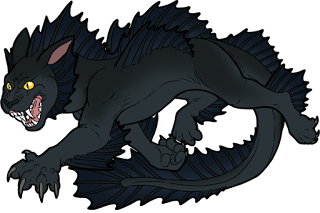
  The cath palug was a monsterous cat from Arthurian legend. Like the rest of Arthurian legend, the cath palug started out in Wales, but was transposed and eventually became more popular in France. The appearance of the cat is rarely described, yet it is said to be an aquatic creature, being part cat and part fish, yet still fully capable of moving on land. The only consistency about the cath palug's appearance is that it's black in color, reminiscent of the many phantom cats seen around the UK. The cath palug was original born from the monstrous pig Henwen, who threw the kitten into the sea. Cath palug survived this ordeal and swam to the isle of Anglesey, where it was found and raised by the brothers Palug. Although eventually they too abandoned the cat as it grew in size and violence until they couldn't care for the creature anymore. In adulthood the cath palug tormented the isle of Anglesey, attacking livestock and people. Nine scores, or 180, heroes faced the cat and ...

Bat Beast of Kent

Image
  The bat beast of Kent was a vaguely mothman like cryptid seen in the English county of Kent. The bat beast was seen in 1963, three years before the infamous events that took place in Point Pleasant, West Virginia. The incident took place near the Saltwood forest, which are known for paranormal strangeness before the incident. The incident being alternately known as the Saltwood ghost and the Hythe mothman, after the nearby village of Hythe. The bat beast overall resembles mothman, but completely lacks a head, eyes or any facial features. It's body is egg shaped and covered in black fur. The wings emerge from the shoulders in place of arms. Oddly the creature also has webbed feet at the end of human like legs. The creature was approximately five feet tall. On November 16 th , four teens identified as John Flaxton, Mervyn Hutchinson and their girlfriends, who remained unnamed through the follow investigation, were walking home along Sandling Road, from a party. On their journey ...

The Dragon of Filey Brigg

Image
  The Filey Brigg is a low, rocky peninsula off the coast of North Yorkshire, right outside the village of Filey. There are many myth of supernatural things happening at Filey Brigg and it's the location of legends and monsters. One such legend is of a fierce dragon living in the waters around the peninsula. The exact time frame of this legend varies, some put it in the medieval era, while others say it only happened a few centuries ago. There was a massive dragon living in the waters off the shores of Filey. It was said said to be a wide range of sizes, up to a mile long in some cases. The dragon was a menace to the area, sinking ships and sweeping people out to sea. No one could approach the shore without risking their lives. The dragon had one weakness however, a love of the local sticky cakes known as parkins. The locals tried to appease the dragon with its favourite sticky cakes, but its apatite could never be satiated. There are multiple different stories about how the drag...