Posts

Nuckelavee

Image
  Nuckelavee is a prominent figure in the folklore of the Orkney Islse, Scotland. He is the most evil and malevolent of all the unseelie fae folk, more comparable to a demon than anything else. Nuckelavee would spend most of his time resting in the sea, only occasionally venturing onto land to torment people. Nuckelavee had the appearance of a horse with a human torso emerging out of its back, like a mutated rider who had merge with their horse. The whole monster was skinless, every muscle and sinew showing. Nuckelavee's body was covered in yellow pulsing veins which carried black blood. The human torso was quite misshapen too. The head was massive, too big for the neck and would roll side to side as Nuckelavee walked. Nuckelavee's arms were so long that even positioned on horse back would reach all the way to the ground. The most terrifying detail was that Nuckelavee had one singular eye that would glow like a lantern through even the thickest night and fog. Although it's ...

Plat Eye

Image
  The Plat Eye is a ghostly undead monster from America Folklore. It's found along the gulf coast, into Georgia and up into South Carolina. The legend of the plat eye was told primarily among African Americans. The plat eye is a ghostly predatory beast, usually a large cat. Its most distinguishing feature is its single large eye, which glows red. Often all a person will see of the plat eye is its glowing eye staring at them from the darkness. The plat eye's body is pale white or grey, like a lifeless corps. Often its flesh is rotten and its guts are hanging out, furthering the undead appearance.   The plat eye can shape shift into the forms of a headless human, a sickly black calf or a black dog. The plat eye can also appear and disappear at will. Plat eyes haunt bayous and crossroads after midnight, and are never seen in the light of day. They fade out of existence in the sunlight. The plat eye surrounds itself in mist and appears out of the fog. Plat Eyes are the restl...

The Nameless Horror of Berkeley Square

Image
  The nameless horror of Berkeley Square is the most Lovecraftian thing I've heard of that wasn't written by Lovecraft himself or his circle of writers. The name of the thing even sounds Lovecraftian. Yet these events predate Lovecraft's writing. Most of them happen before he was even born. The nameless horror is intrinsically tied to it's location, 50 Berkeley Square in London England. It is known as one of the most haunted buildings in all of London. The building itself has a long history being built in 1740. Not long after it already was reported to be haunted. The first stories about specific spirits started in 1789. Adeline, a woman who had lived in the house, was found dead outside on the pavement. She had jumped from the upper floors to escape abuse from her uncle. After her untimely death people started seeing her apparition as a ghostly woman in white wandering the hallways, and disconnected crying from an unseen woman. Another early ghost from the 18 th cen...

Manananggal

Image
  The manananggal is a vampiric monster from the Philippines. It is most often found in the Visayan region of the country. The manananggal is found both in older folk lore and modern cryptid reports. It is typically seen in rural areas, flying over rice fields and small villages, and it's believed that city lights may harm the monster, as does daylight. Manananggals are flying human torsos. They are almost always female. During the day manananggals are attached to a set of legs and hide their wings, blending in with the human population. At night they go through a transformation, growing bat wings, long claws and a proboscis like tongue, and separating their torso off from their hips and legs. The head, arms and torso then fly off into the night with their bat wings to find victims to consume. Manananggals only have power at night in the darkness. During the day they remain joined with their torso and appear as normal humans. It's only at night when they're capable of fly...

Locusts of Abaddon

Image
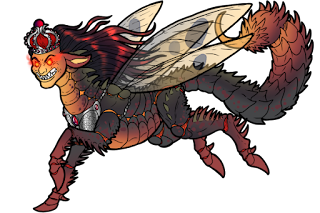
  The locusts of Abaddon are a type of monster that appears in the book of Revelations. They had the head of a man, the teeth of a lion and the long flowing hair of a woman. They had horse like bodies, wings and scorpion tails. They were also wearing crowns and iron breast plates. No part of the demonic locusts were insect like. The insect shell and wings are my own interpretation, as Revelations doesn't state what kind of wings they have. Referring to these demons as locusts comes from their vast numbers, which is like a locust swarm. The locusts were released from the bottomless pit by Satan after the fifth angel blew their trumpet. The locusts were commanded by the demon Abaddon, also known as Apollyon, his name meaning the destroyer. The locusts were commanded to not harm the natural life of Earth but only attack sinners, or the men who did not have the seal of God on their foreheads. Even then the locusts were not to kill the sinners, but just torture them relentlessly for fi...

Snallygaster

Image
  The Snallygaster is a monster that sits somewhere between lumberjack folklore and actual cryptid. In spite of it's ridiculous appearance, rivalry with another monster, and humorous stories, people have reported seeing it in earnest, some sightings being as late as the 1930's. The Snallygaster originates near the South Mountain in Maryland, but sightings and legends of it range as far away as West Virginia and Ohio. The Snallygaster looks like a cross between a bird and a dragon. It has large horns on its head. The Snallygaster's strangest and most notable features are having octopus like tentacles and a single glaring eye. Other than this short description the Snallygaster's appearance can varying greatly. Sometimes it has a set of front legs, other times it only has back legs like a wyvern. The Snallygaster's body can be long and twisting like a serpent, or short and squat, with its length being made mostly of its neck and tail. Even the location of its tentacl...

Calopus

Image
  Many real creatures were turned into mythical beasts in the Medieval era. The hyena inspired the crocotta, the wildebeest the bonnacon and the ibex the yale. Yet few beasts have strayed so far from their real life inspiration as the antelope and the calopus. The antelope was first known in Europe by the ancient Greeks, who called it antelopos. The records of Alexander the Great called them aeternae and the Romans called them calopus, which means pretty foot. The name calopus continued through the Medieval period as a mostly separate creature from antelopes. Medieval bestiaries varied on whether they had entries on the calopus, antelope or both. Eventually the calopus became a symbolic beast in heraldry, where it gained its most unfamiliar form yet. The antelope known to the ancient Greeks was considered a fearsome beast, yet it still had the overall form of a goat or a roe deer. The calopus had dangerous serrated horns which it used to shred tree branches. It would hesitate to ...