Posts

Physeter

Image
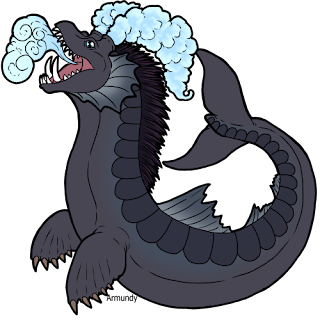
  In the medieval era and earlier, so little was know about whales that they were regarded in the same manner as dragons and sea serpents. Today physeter, meaning blower or whirlpool, is the genus name of sperm whales. And while the name always referred this species of whale, what was believed about their appearance and behavior was worthy of being called a mythical beast. The earliest surviving accounts of physeter was from Pliny the Elder. He states that it was the largest beast in the Sea of Gaul, today known as the North Atlantic. According to Pliny the physeter would rise itself up in a column above the masts of ships and spray out water from its head in a fountain like torrent. The physeter was often found in medieval bestiaries, where it was described as a giant fish with a horse like head and neck. It's head had two spouts from which it could spray out water. A horse like mane ran down the back of its neck. Often the depiction would end here, with the body hidden beneat...

Odontotyrranus

Image
  The odontotyrranus is a giant and fearsome monster that attacked Alexander the Great as he entered India. The beast is described as being larger than an elephant, having a bull like body, and horse like head. Its most notable features were three large horns on its head and a wide mouth full of predatory teeth. The beast was also semi-aquatic and wallows in water like a hippopotamus. It was black in color and its head was darkest. Its name means toothy tyrant. The legend of the odontotyrranus states that Alexander's men made camp by a river after entering India. Two different versions state that the odontotyrranus either came down to the river to drink, or was wallowing in the water and lunged out of the river at them. Alexander's men fought the beast as it rampaged through their camp. It killed 26 men and injured 52. The odontotyrranus was carnivorous and able to swallow a human whole with ease. One of Alexander's commanders, Emendus, Duke of Arcadia finally brought the b...

Nguruvilu

Image
  The nguruvilu is a monster from Mapuche legend in Chile. It looks like an elongated fox, which can coil around like a snake. It's still fur covered like a fox. It has long sharp claws. The name nguruvilu means fox snake in Mapuche. The nguruvilu lives an amphibious life in rivers and can hide itself in the form of common water creatures. It's a dangerous trickster who drags people underwater and drowns them. The nguruvilu can make the water deep or shallow. It can make the river look inviting to lure people in and can also make whirlpools and rapids at will. It delights in drowning lone victims and watches the village morn. The only way to get rid of an nguruvilu is through the efforts of a machi, the Mapuche version of a shaman. At the river's edge the machi will make offerings to the gods and good spirits to protect him. Then he will dive underwater and guided by good magic will capture the nguruvilu in the form of a fish, frog or snake. He then threatens the nguruvi...

Makara

Image
  The makara is an aquatic chimera originating in Hindu mythology, but also found in Buddhism. It's legend is known in many countries, including India, Sri Lanka, Nepal, and all over South East Asia. The name makara means water monster in Sanskrit. The legend of the makara is very old, as images of it date back to the Vedic era (1500 BCE). The Makara's appearance is extremely varied. At it's most basic the makara is a chimera of mammal in the front and a water living creature in the back. The most common combinations are an elephant or stag head with a crocodile, fish or whale body. The makara may also have a peacock's tail on occasion. Older depictions of the makara had even more animals mixed in, in addition to the ones listed above it could also have boar's tusks, lion's paws and mouse's ears. The makara symbolized the might and power of water, such as floods, rapids and tides. It also represented the dangerous animals that lived in water, especially cr...

Llamhigyr Y Dwr

Image
  The llamhigyr y Dwr was a troublesome water spirit from Wales, especially well known from the lakes of Llyn Gwynant and Llyn Glas. Its name means water leaper. The llamhigyr y dwr had a large frog like head, bat wings for forelegs, no back legs and a long lizard like tail ending in a spike. The creature was quite large, comparable to a crocodile. While the llamhigyr y dwr was capable of flight it preferred to hide beneath the water. The llamhigyr y dwr would devour anything that would fit in its mouth. Shepherds wouldn't bring their flocks to the lake to drink, and people would keep their dogs and children away from the waters edge. If the llamhigyr y dwr's target managed to escape its reach it would use it tail like a whip to grab and pull its prey back into the water. Otherwise it would just leap out from the water's edge mouth first and swallow its prey whole. The llamhigyr y dwr would also rob bate and catches off fishing lines, and even overturn boats in an attempt t...

Knucker Dragon

Image
  The knucker dragon was a water dragon who lived in a pond in Sussex England during the medieval and renaissance periods. It was a water dragon, but didn't have many water like features to its appearance. It looked like a stretched out western dragon with a long serpent like body. It is consistently depicted as red in color. The dragon was also considered unusually clever and conniving, and was capable of talking, which usually wasn't something dragons were capable of doing until modern fantasy. The name knucker is derived from words like nix or nacken, showing a connection back to malicious water fae. The pond the dragon inhabited is known as the knucker hole, and still exists on the Somptings Estate. Legend goes that the knucker dragon was quite a threat to the surrounding communities, coming out of its pond at night and eating livestock and people. The people begged an authority figure, in some version the local mayor of Lyminster, in other version they went all the way t...

Jimplecute

Image
  The jimplecute is a vampiric reptile from Ozark legend. It is a rarely heard of fearsome critter and shouldn't be confused with the gowrow, the more famous reptile from the region. There are two different descriptions of the jimplecute. The original appearance is of a long serpentine reptile, yet still baring short legs. It has skin the texture of dead leaves, which allows it to hide better in the forests. It even had the chameleon like ability to change color, so to blend in with leaves of different seasons. This jimplecute is able to wrap around its victims like a python to immobilize them while it feeds on their blood. The more modern version of the jimplecute is of a vampiric dinosaur, usually something similar to a raptor. This interpretation comes from the book We Always Lie to Strangers by Vance Randolph, which is a book about Ozarks folklore. There Mr Randolph describes the jimplecute as a prehistoric. Although I think he meant that all reptiles are primitive in his e...