Posts

Xiangliu

Image
  Xiangliu was a serpent with nine human heads. Sometimes the head each have different necks, and other times the head form a cone or a grid, all beside each other. In spite of this monstrous appearance, Xiangliu was intelligent and a minister to the equally monstrous water god Gonggong. Xiangliu was responsible for enacting Gonggong's orders to bring floods and devastation to the land. Xiangliu's mere presence was able to cause devastation everywhere he went. Everywhere he breathed became a bog with poisoned water. He was also immoral and took glee in destruction he caused and the suffering he created for others. When Gonggong rebelled against the heavens Xiangliu fought by his side. However once the goddess Nuwe killed Gonggong Xiangliu fled. Yu the Great, the last of the three sage kings, tracked Xiangliu to the swamps of Sichuan Province. He killed Xiangliu after a pitched battle. However Xiangliu's blood threatened to poison the whole region. If Xiangliu was left t...

Yeongno

Image
The yeongno is a demon from korea. There is little written about it and no folk tails where it appears. Instead the yeongno come from korean theatre, specifically small local plays to entertain the common folk. The type of theatre it appears in is the gamyeongeuk, a type of play where actors wear masks to play stalk characters, and the Kkokdugaksinoreum, a puppet show. These plays with the yeongno were performed to mock the yangban. The yangban were the wealthy elites of past Korea's highly stratified society. In these plays the yeongno is banished from heaven for some crime which isn't eluded upon. To reenter heaven the yeongno has to eat 100 yangban. The yeongno would creep up on the yangban and play it's willow pipe with a distinct bibibi tune, to strike fear in the yangban who was being stalked. This gives the yeongno it's alternate name of Bibi. The yeongno costume consists of a mask with a long crocodile like snout, and a long robe or blanket with scale pattern...

Wawel Dragon

Image
  The Wawel dragon, also known as Smok Wawelski and the dragon of Krak ó w. It's legend is tied with the founding of Krak ó w and the life of its earliest ruler, King Krakus. The earliest account of the dragon comes from the 13 th century. No description of the dragon's appearance is given in the legend. However there's a statue of the dragon at the foot of Wawel hill in Krak ó w, near the entrance of a cave known as the dragon's den. This statue depicts a strange and spiky looking dragon with eight legs and fin like wings. The legend goes that in the time of King Krakus, the legendary founder of Krak ó w, a dragon lived in a cave under Wawel Castle. The dragon would ravage the countryside, devouring people and livestock. To avoid the dragon's wrath people would satiate it's hunger with three cows and three rams a day, a hefty toll in livestock. Many knights tried to slay the dragon but none succeeded. Then a cobbler named Scuba came up with a plan. He fille...

Vishap

Image
  Vishap is a dragon from Armenian mythology. He was depicted as a serpent with wings, often with features of other animals, such as horns. Vishap was closely associated with water. He was also venomous and able to taint everything around it, and associated with bad luck, curses and sudden tragedy. Vishap was thought to live in the Armenian highlands, especially Mount Ararat. The volcanic activity of Mount Ararat was attributed to Vishap. Vishap was also associated with thunderstorms, causing them when he ascended into the sky or descended back down to the ground. He was even responsible for eclipses. Unusual for dragons, but much like European fairies, Vishap was thought to steal children and replace them with a dragon whelp from its own brood. Vishap was slain by Vahagn, an important god in ancient pagan Armenia. He was the god of war, bravery and the sun. Vishap himself was also worshipped as an earlier god of water and fertility before becoming purely a monster. Vishap is also ...

Ushi Oni

Image
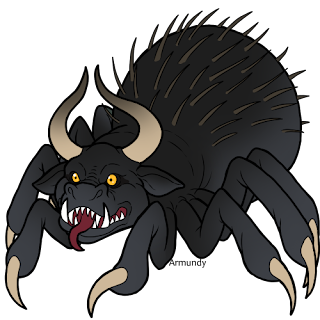
  The ushi oni is a monstrous yokai found in western Japan, usually along the coast or near rivers and waterfalls. The name mean ox demon. The most common depiction of the ushi oni is one with a bull's head and a spider's body. Although the spider part is just supposed to represent 'a form of demonic evil' and isn't inherently connected to spiders. However the name ushi oni refers to many local monsters with varying appearances. Ushi onis are cruel and violent monsters. They almost exclusively eat people. Occasionally they are said to attack live stock, but this is usually to lure people out. Ushi onis also breath out toxic gas and spread a variety of diseases. Ushi onis have a variety of behaviors and ways of hunting people. Some lay in wait in their layers and pounce upon unaware victims. These layers are usually along the coast in sea caves, as well as inland in dangerous river features such as whirlpools and waterfalls. Some rare ushi oni live far inland,...

Tompondrano

Image
  Tompondrano means lord of the water in Malagasy. The name is used for both ordinary water snakes and a mythical giant water snake. The tompondrano is believed by multiple different cultures in Madagascar, who each have slightly different interpretations. While the creature is usually thought of as a giant snake, various groups in Madagascar also see it as other creatures, such as whales, sharks, crocodiles and even pilot fish. Most legends about the tompondrano are of a fresh water creature, but some groups see it as a sea creature, or able to move between both kinds of water. The tompondrano is believed to be a regular water snake that was blessed by the Vazimba, a mythical race of fae like people who live in the center of Madagascar. This made the tompondrano sacred and granted it magical powers over water. Such sacred associations were extended to all water snakes, which people were forbidden from harming. And if one was found dead it would be wrapped in silk in the same mann...

Skeljaskrimsli

Image
  Skeljaskrimsli is a monster or cryptid that was reportedly seen on Icelandic beaches from between the 1780's to the 1910's. Its name means shell monster. Alternately known as fjorulalli (beach walker) or Saeulfur (sea wolf). The skeljaskrimsli is a large bear shaped creature. Individuals vary in size from wolf sized to horse sized. The creature has long fangs or tusks, long claws, an arched back and long tail that ends in a club. It's most notable feature is its coat of shells or pangolin like scales completely covering its body except the belly and lower limbs. These shells would rub together and create a lot of noise, warning of its presence. The creature was dark in color, like mussel shells, with red eyes and sometimes a bioluminescent mouth. People could hear the skeljaskrimsli approaching long before it was seen. As it came closer it also gave off a powerful stench. It's fortunate that this creature gave such warnings of its approach, as it was quite violent. ...