Posts

Valravn

Image
  Valravn, meaning raven of the slain, is a sort of boogieman from Denmark. Valravns were created when a raven ate the flesh of the fallen in battle who had not been given a proper burial. The valravn was a thoroughly evil creature that sought to bring harm to the surrounding communities. After being transformed the valravn gained human intelligence and various magical abilities that allowed it to spread pestilence and misfortune. It also gained the ability to shape shift into wolves or a half wolf – half raven form. Even with these abilities valravns still sought out more power. The one thing they desired the most was the ability to take on the form of a black knight, which they could only gain by devouring the heart of a child. How they accomplished this was usually left to the imagination. However in one traditional Danish song a valravn offered to protect a maiden on her way to her marriage in return for her first born child, echoing similar trickster deals made with fairies an...

Gowrow

Image
  The Gowrow is a fearsome critter from Arkansas. It's considered a species, rather than one individual. There exists multiple different stories of hunters and locals defeating a troublesome gowrow by differing means and in different locations. It's also said that the females carry their soft shelled eggs around in a throat pouch, implying a breeding population. The gowrows are giant reptilian monsters. They're 20 feet long from snout to tail and resemble giant lizards or wingless dragons. Gowrows are said to have massive jaws with even larger tusks, either like those of a hippopotamus or a wild boar. They have a row of bony spikes down their backs and long reptilian tails that end in a blade or a spike which they can use as a weapon. Gowrows have strong front arms which they can use to uproot entire trees and dig through solid rock. The feet are usually, but not always, webbed and and the Gowrow is considered a good swimmer. Besides these qualities, the over all body shap...

Luduan

Image
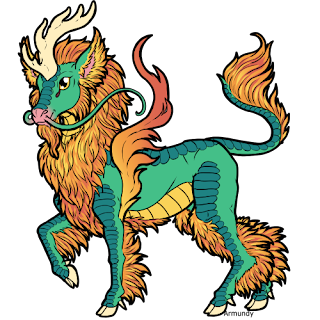
  Everyone has heard about qilins. Although fewer people realize that the qilin is not as unicorn like as it is typically depicted. The qilin was originally depicted with two horns before comparisons between it and western unicorns were made. However there are other one horned beasts in Chinese mythology, several in fact. One being the luduan, which shares many aspects with both qilin and unicorns, and had a single horn before western influence. Written descriptions of luduan depict it as deer like, green in color and having a single antler or horn. Sculptural depictions instead show the luduan as a cat like creature with paws. Legends about the luduan say it could run 18 000 li in a day (7000 km), speak every known language and detect the truthfulness of a speaker. The luduan was a peaceful creature who hated violence in any form. Accounts by Buddhist monk, Yelu Chucai say the luduan appeared before Genghis Khan and convinced him to abandon his conquest in India. Although it's ...

Wamp

Image
  The wamp ( Caudasal lakeshorekearni ) is one of the fearsome critters of lumberjack lore. It was a small and peaceful creature. The wamp was about the size of a raccoon and has a salt bag shaped body. It had a long, hollow tail with a salt shaker at the end and it would use this tail to leave salt licks for deer over the winter. Hunters caught wise to this and started following the wamp around to more easily find deer. So the wamp's efforts to help deer ended up in them being hunted down instead. Because April Fools is tomorrow I wanted a feature a light hearted and silly creature this time.

Python

Image
  Everyone knows about python snakes, but fewer people know about the ancient Greek dragon the genus was named after. It does tend to get lost in search results, after all. Python is described by Hyginus as being a giant snake, not unlike it's real life counterparts. Although the dragon Python was said to be venomous. In later depictions from the medieval era onward Python is depicted as a more typical dragon, with legs and wings. Python first appeared when it was sent by Hera to torment Leto after Zeus took interest in her. Once Apollo was born he sought to avenge his mother's constant torment by slaying Python. In some versions of the myth Apollo accomplished this while he was still a child. Apollo pursued Python to Delphi, where he had to enter sacred ground to slay Python. In some versions of the myth it was Python's blood that gave the location of Delphi its prophetic qualities, in other versions Delphi's placement at the centre of the world already gave it thes...

Monoceros

Image
      The monoceros is an animal that is mentioned by many Greek and Roman authors. Many people assume the monoceros was just a rhinoceros, however its description differs quite a bit from a mere rhino, and it was probably a mythical amalgamation of different animals. The description was added to multiple times by subsequent authors, further elaborating on the monoceros's attributes.      The monoceros was first mentioned by  Megasthenes, who was a Greek explorer who travelled to India. It's likely out of all the authors who wrote about the monoceros, Megasthenes was the only one who actually saw a rhinoceros. Yet, his description still doesn't quite fit a rhino, as he said the creature had the head of a stag and a horn two cubits long, which would be nearly 3 feet. The monoceros was also said to live in the foothills of the Himalayas, rather than in the lowlands where rhinoceros are actually found. Still Megasthenes' description does have a fair bit i...

Zheng

Image
  There's not much information on this creature. The zheng is mentioned in The Classic Of Mountains And Seas, which is a compilation of mythic geography and beasts, similar to the medieval bestiaries from Europe. The zheng was described as a red leopard with a single horn and five tails. It was ferocious and brutal, as you would expect from a large cat. And it sounded like striking stones. It lived high up on Mount Zhang'e, above the tree and grass line, where there was only stone. In spite of it's fanciful appearance, the zheng was considered a natural animal.