Posts

Bies

Image
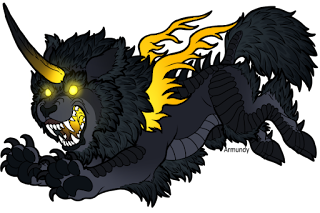
  Bies, also called Bes and Biesy, was a type of demon from Slavic mythology and paganism. They were known throughout eastern Europe. Bies had no consistent appearance other than it was beast like. Often depicted as either an anthropomorphic or beastial mish-mash of different animals, combining hoofed animals and predators together. It was a primeval nature spirit. Even in paganism it was considered a demon, personifying chaos, evil and everything uncontrolled in nature. Bies demons lived in mountain ranges, untouched forests and swamps, anywhere that human habitation had not encroached on nature. Beis's name means fury or rage, and was used as a euphonious for insanity, as it would cause this condition in it's victims. When a human enters the bies's home it can hypnotize and take control of the human, driving them mad and filling them with panic. If the human some how staves off such attacks and meets the bies face to face the bies will attack with more ferocity than any ...

Unicorns of America

Image
  You would think that belief in unicorns would have ended in the medieval era and by the time the Americas were being explored people would have moved on from such notions. On the contrary, with all the strange wildlife being discovered around the world in the age of exploration interest in the possibility of unicorns was reignited in the minds of explorers and naturalists. In 1539, in the area of New Spain which would today be New Mexico there were reports by Friar Marcos de Niza that there existed a city of gold beyond the Zuni Pueblos. He said he had visited this city and seen untold treasures there. Some of these treasures he described in great detail, including the hide of an unknown animal. De Niza said it was like that of a large bull, but had a single horn on forehead, which pointed back towards its breast. No cities or creatures like these have ever been found. Its unknown what Marcos de Niza saw, or if he had made up the entire report, and why.   The next unicorn w...

The Van Meter Visitor

Image
  In October of 1903 the town of Van Meter in Iowa had multiple encounters with a strange, bird like cryptid, which was later nick named the Van Meter Visitor. The creature had leathery, featherless skin, a bird like head with a beak filled with teeth and leathery bat like wings. The most unusual feature of the cryptid was that it had a glowing horn jutting out from the center of its forehead. Some people reported seeing a more humanoid creature, which stood upright, and had its arms replaced by bat like wings. While others reported a more animalistic and pteranodon like being. Whichever version they saw, people consistently reported the same details about its strange head. The people who reported the sightings were some of the most prominent and upstanding members of the area. The first sighting was witnessed by U G Griffith, a well know businessman in town. He was returning late at night from his work, around 1 o'clock in the morning, when he saw a light on top one of the buildi...

Codrille

Image
  The codrille was a medieval dragon from France. Its overall appearances was a mix of cockatrice and wyvern, and was between them in size as well. The codrille also had the notable addition of a glowing crystal horn jutting out from its forehead like a demented unicorn horn. While it would be easy to write off the codrille as just a hybrid of two other monsters, there's far more to its legend than just that. First off, it's name is derived from crocodile. Travellers brought back tales of crocodiles from Egypt, with their name and description being mangled and combined with cockatrice into the codrille, which is also sometimes known as the cocodrille. The codrille has an interesting life cycle for a dragon. It starts out born from a yolk-less egg. The legend varies on whether this egg is laid by a chicken or another codrille, but there are specific nesting sites where the eggs can be found. The egg is left out to incubate in the heat of the sun. The codrille then hatches out ...

Xiezhi

Image
  The xiezhi was said to be a single horned ram, with black fur and burning eyes. Although in artistic depictions it more often looks like a cross between a qilin and a lion, always with a single horn or antler. The xiezhi is an ideally just beast and can intrinsically distinguish between the just and unjust people in the world. It is a highly intelligent beast and can understand all human languages. The xiezhi will hunt down evil doers and stab them with its single horn and devour them. It was believed that the legendary emperor Shun had a captive xiezhi, who would preside over court hearings and ram the guilty party. The censorate of the Ming and Qing periods wore xiezhi badges as a sign of their office. Among common people the image of the xiezhi was believed to ward off evil and protect them from crime. Similar creatures could be found in other parts of Asia. In Japan it was known as the sinyou and in Korea it was known as the haetae.  

The Garson Invaders

Image
  Back in my introductory post I said I would cover cryptids too, and I've yet to do that. So it's about time I covered something on the forteans side of things. On July 2 nd , 1954 Candian Italian miner, Ennio La Sarza witnessed a strange object in the sky outside Garson Ontario, a small nickel mining town near Sudbury. The incident happened at 5 pm that day, and in the northern latitude of Garson days last long into the evening, so there was still ample daylight at 5 pm. Shortly after the object appeared it hurtled town towards the ground, faster than any jet, La Sarza reported. Yet before it crashed into the ground it slowed down, deployed its landing gear and landed gently. La Sarza described the space craft as being roughly spherical in shape, 25 feet in diameter and having a circle of port hole windows encircling it's middle. Once the space craft had landed a door opened up and lowered down like a ramp. Three creatures emerged. Although only one of them approached ...

Al Miraj

Image
  The al-miraj is one of those monsters who's on the edge of being well known. More and more people have heard of it as of recently, but few people know anything about it other than being the 'unicorn bunny'. The al miraj comes from the Arabic translations of the tale of Alexander the Great. In this account Alexander travels to Jazirat Al-Tinnin, or Sea Serpent Island. There the locals are being tormented by a serpent like dragon who is devouring their livestock. Alexander defeated the dragon by filling a cow hide with poisonous substances. The dragon subsequently swallowed the decoy and was killed. For his efforts the islanders gave Alexander the al miraj as a gift. The al-miraj is always depicted as a horned rabbit or hare that's golden yellow in color. It tends to vary more in image then it does in written description. Occasionally the al miraj is drawn with leopard spots, or a gazelle stripe, while other times it's left plain. The texts always describe the al...