Posts

Llamhigyr Y Dwr

Image
  The llamhigyr y Dwr was a troublesome water spirit from Wales, especially well known from the lakes of Llyn Gwynant and Llyn Glas. Its name means water leaper. The llamhigyr y dwr had a large frog like head, bat wings for forelegs, no back legs and a long lizard like tail ending in a spike. The creature was quite large, comparable to a crocodile. While the llamhigyr y dwr was capable of flight it preferred to hide beneath the water. The llamhigyr y dwr would devour anything that would fit in its mouth. Shepherds wouldn't bring their flocks to the lake to drink, and people would keep their dogs and children away from the waters edge. If the llamhigyr y dwr's target managed to escape its reach it would use it tail like a whip to grab and pull its prey back into the water. Otherwise it would just leap out from the water's edge mouth first and swallow its prey whole. The llamhigyr y dwr would also rob bate and catches off fishing lines, and even overturn boats in an attempt t...

Knucker Dragon

Image
  The knucker dragon was a water dragon who lived in a pond in Sussex England during the medieval and renaissance periods. It was a water dragon, but didn't have many water like features to its appearance. It looked like a stretched out western dragon with a long serpent like body. It is consistently depicted as red in color. The dragon was also considered unusually clever and conniving, and was capable of talking, which usually wasn't something dragons were capable of doing until modern fantasy. The name knucker is derived from words like nix or nacken, showing a connection back to malicious water fae. The pond the dragon inhabited is known as the knucker hole, and still exists on the Somptings Estate. Legend goes that the knucker dragon was quite a threat to the surrounding communities, coming out of its pond at night and eating livestock and people. The people begged an authority figure, in some version the local mayor of Lyminster, in other version they went all the way t...

Jimplecute

Image
  The jimplecute is a vampiric reptile from Ozark legend. It is a rarely heard of fearsome critter and shouldn't be confused with the gowrow, the more famous reptile from the region. There are two different descriptions of the jimplecute. The original appearance is of a long serpentine reptile, yet still baring short legs. It has skin the texture of dead leaves, which allows it to hide better in the forests. It even had the chameleon like ability to change color, so to blend in with leaves of different seasons. This jimplecute is able to wrap around its victims like a python to immobilize them while it feeds on their blood. The more modern version of the jimplecute is of a vampiric dinosaur, usually something similar to a raptor. This interpretation comes from the book We Always Lie to Strangers by Vance Randolph, which is a book about Ozarks folklore. There Mr Randolph describes the jimplecute as a prehistoric. Although I think he meant that all reptiles are primitive in his e...

Ivanitsky Creature

Image
  During the early 1990's, in the village Petropavlovsk, Russia, was an encounter with one of the strangest cryptids I've ever heard of. This location was hardly a stranger to fortean weirdness, as it was the home to ghost lights, ufos and sightings of flying humanoid creatures. Yet the Ivanitsky creature stands out even among such sightings. The Ivanitsky family had just moved into the area, likely not knowing about the local's history with high strangeness. The first unusual thing they encountered was unexplained chirping noises coming from various parts of their house, in the walls, the attic, and so forth. Yet the family just assumed it was crickets. After a little over a week of these occurrences, the chirping started to come from under the bed of one of the sons. Father Ivanitsky took a look under the bed and saw a ball of fur. He assumed it was a stray dog that had somehow entered the house and curled up there. Father Ivanitsky used a broom handle to force the creatu...

Hadhayosh

Image
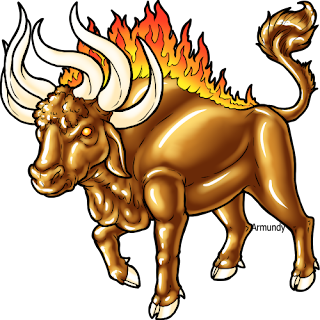
  The hadhayosh was a giant bull from Persian mythology. It was also known as the sarsaok. The hadhayosh had six horns and a flaming mane. It's body was made of brass. There were multiple hadhayoshes made, each one exactly 52 feet tall and 57 tons in weight. The hadhayosh were created by 'the god of the forge'. While there are various angels or lesser gods in Zoroastrianism, I couldn't find exactly who this god of the forge was. Possibly Khshathra Vairya, the angel of metals, that would be my best guess. The hadhayoshes were primordial beings who were created right after the earth was finished. They were tasked with carrying the newly created humanity across the Voutkasha sea from the land of the gods to the know world. Once they had reached the mortal world the hadhayosh acted like normal cattle, grazing on the ample grasslands. The hadhayosh were slain and prepared like cattle by the newly arrived humans. When the hadhayosh were slain 55 species of grain and 12 spe...

Grootslang

Image
 The grootslang is a monster, or possibly two monsters, from South Africa. The word grootslang literally means 'big snake' in Afrikaans. The first type of grootslang is purely mythical in nature and comes from the creation myths of pre-Christian stories, specifically those of the Zulu people. When the gods finished creating the land of the Earth they started creating the various creatures that would live on it. They made an entire species of grootslangs. These beings were a hybrid of snake an elephant, having the grace and agility of snakes, and the cunning and strength of elephants together in one being. This being their very first creation, the gods were inexperienced and didn't know how powerful they could make a creature before it was dangerous. When they made other animals the grootslangs would hunt them all down and kill them before they could get established. So the gods rounded the grootslangs up and pulled each one apart into two separate animals, a snake and an el...

Falak

Image
  Falak is a gigantic snake from Arabian legend. It's larger than the whole world combined. Falak resides in the abyss, the seventh and final level of hell. The other levels of hell are held in its mouth. In Arabian mythology the world is carried on the back of an angel, who stands on the celestial bull Kuyuta, who in turn stands on the whale (not dragon) Bahamut. Bahamut in turn swims in the celestial ocean, which are the surface waters leading to the abyss. Falak desperately wants to reach up out of the abyss and devour all these other beings and the whole world. It's only the fear of God's punishment that stops Falak from doing so. God also gave Falak the other six levels of hell to hold to keep it busy and not focused on destroying the world.